
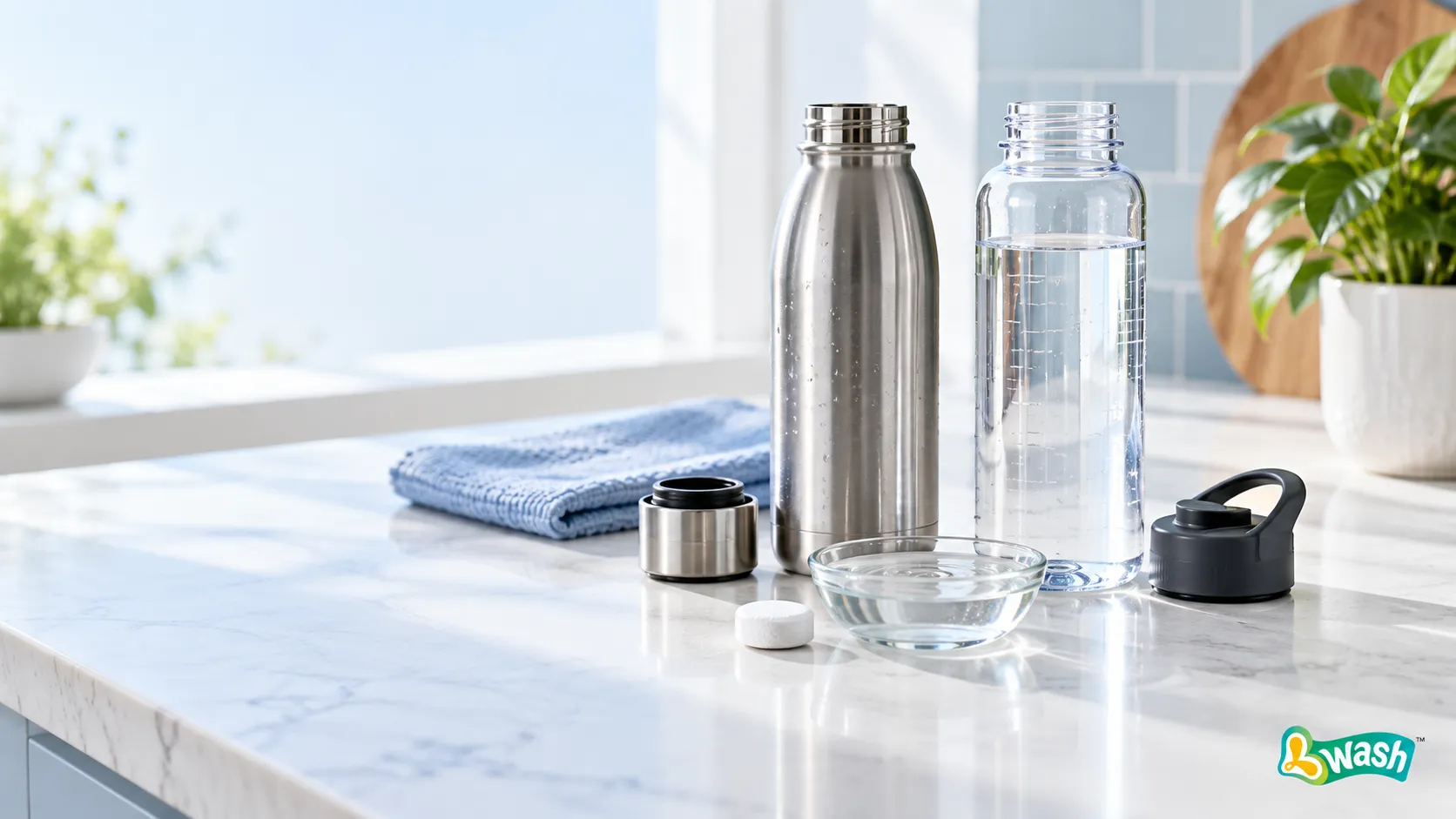
Water bottle cleaning tablets are dissolving cleaners designed to soak the inside of compatible reusable bottles. They can help loosen certain stains and mineral buildup when the tablet directions, bottle material, water temperature, dose, contact time, and rinsing steps are followed. They do not replace regular cleaning of lids, straws, valves, and seals, and an ordinary cleaning tablet should not be treated as a disinfectant or sterilizer.
This guide explains when bottle cleaner tablets are useful, how to use them correctly, where manual cleaning still matters, and what private-label buyers should verify before approving a finished product.
Reviewed: September 11, 2026.
Water Bottle Cleaning Tablets: Quick Answers
| Question | Short answer |
|---|---|
| Do water bottle cleaning tablets work? | They can help with label-supported stains and buildup inside compatible bottles. Results depend on the formula, bottle material, residue, dose, soak time, and rinsing. |
| Are they a replacement for washing? | No. Caps, gaskets, straws, valves, threads, and other removable parts may still need separate washing or brushing. |
| Can they be used in stainless-steel bottles? | Only when both the tablet label and bottle-care instructions allow it. The current LWASH sample label includes stainless steel, silicone, and plastic bottles. |
| What ingredients do they contain? | Formulas vary. Check the finished ingredient statement, warnings, and SDS when available rather than assuming that all bottle cleaning tablets use the same formula. |
| Do they disinfect or sterilize? | Not unless the exact finished product has the required evidence, registration, approved claims, and label directions for that purpose. |
| How often should they be used? | There is no universal schedule. Continue routine bottle washing and use a tablet only at the frequency allowed by both labels. |
In this guide
- What bottle cleaning tablets are
- Whether they work
- How to use them
- Tablets, soap, brushes, or dishwasher
- Parts and materials to check
- Cleaning versus disinfecting
- Private-label buyer checklist
- Frequently asked questions
What Are Water Bottle Cleaning Tablets?
Short answer: They are compact tablets that dissolve in water to create a soak-cleaning solution for compatible reusable bottles and drinkware.
The tablet format is useful when a bottle has a narrow opening or an interior that is awkward to reach with a brush. A soak can bring the cleaning solution into contact with the bottle wall, but it does not guarantee that every hidden surface, removable component, stain, or odor source will be fully addressed.
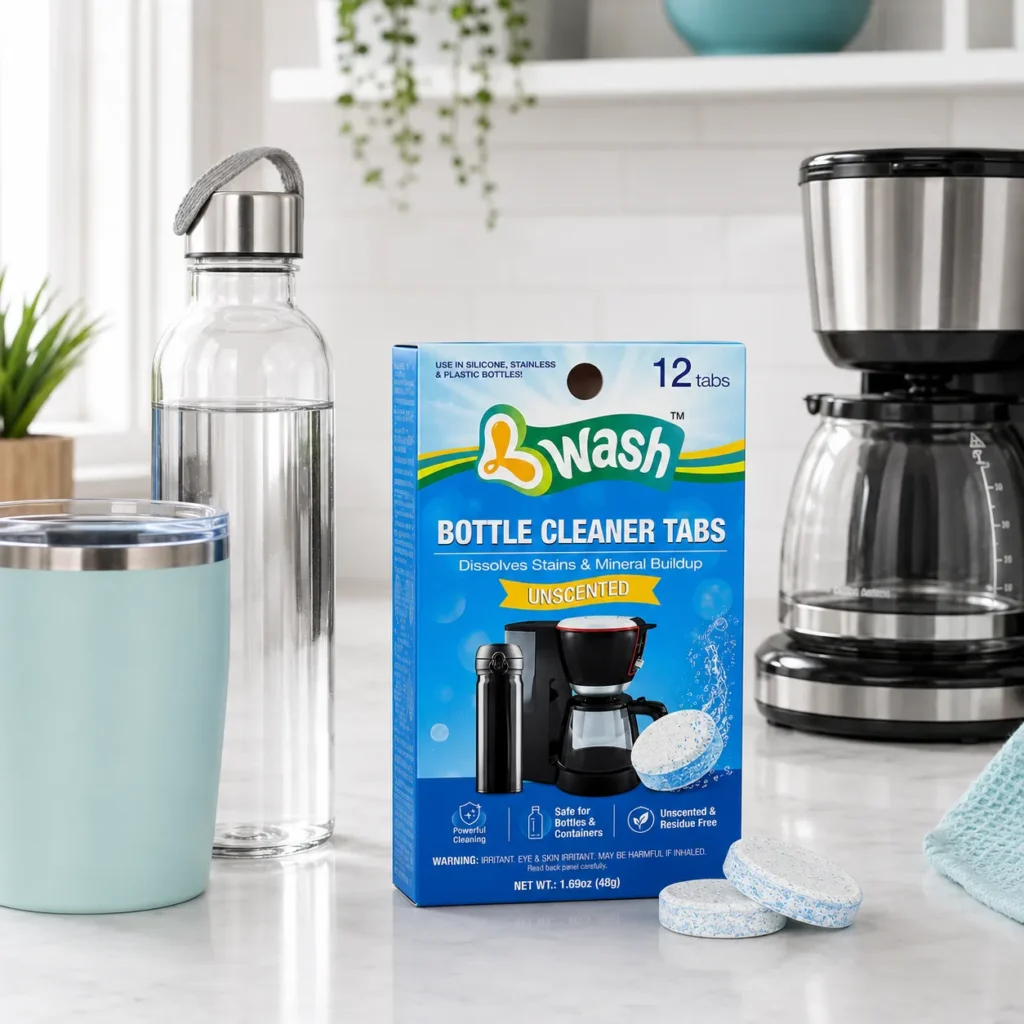
The current LWASH bottle cleaning tablets sample is a 12-tablet, 48 g, unscented retail format. Its visible directions cover routine soak cleaning of suitable silicone, stainless-steel, and plastic bottles and state that the product helps dissolve stains and mineral buildup when used as directed.
Do Water Bottle Cleaning Tablets Work?
Short answer: They can help with the cleaning tasks and materials supported by the finished label. Results depend on the formula, bottle material, type and condition of the residue, dose, soak time, rinsing, and the condition of the bottle.
A tablet has the best chance of helping when the bottle is compatible, the correct amount of water is used, the full soak time is allowed, and the bottle is rinsed as directed. The current LWASH sample label supports routine soak cleaning and states that the product helps dissolve stains and mineral buildup. Other residue, taste, odor, or beverage-specific claims require separate finished-product support.
How Do You Use Water Bottle Cleaning Tablets?
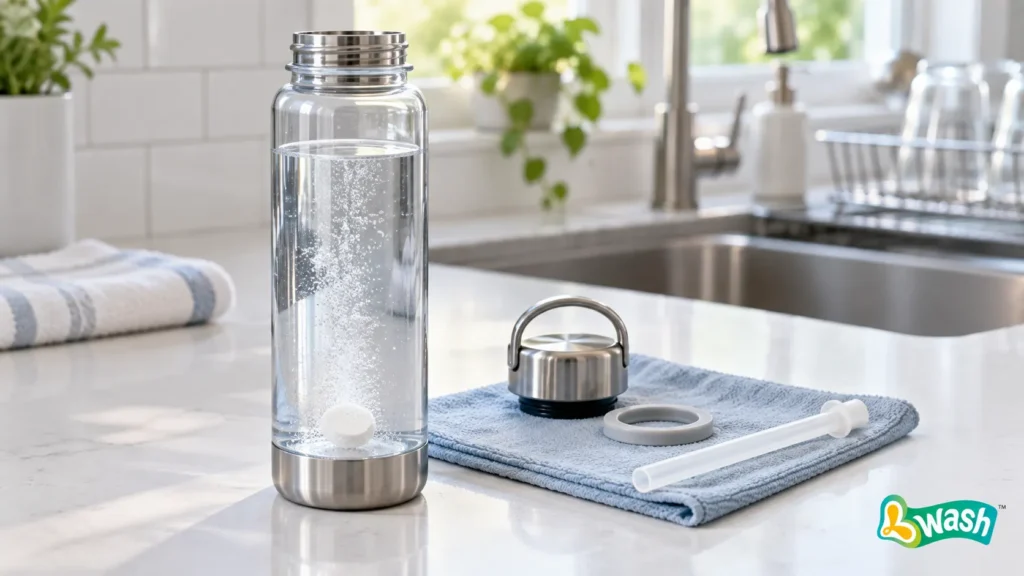
Short answer: Check both labels, use the specified water temperature and dose, leave the bottle open if directed, allow the full contact time, then empty and rinse thoroughly.
- Check the bottle-care instructions. Confirm its material, finish, removable parts, dishwasher status, and any prohibited cleaners.
- Empty the bottle and remove accessible parts. Separate the cap, straw, gasket, valve, or sleeve only as the bottle manufacturer permits.
- Follow the tablet label exactly. Do not copy another brand’s dose, water temperature, or soak time.
- Keep the container open when directed. The current LWASH sample directs users to leave the container open during soaking; do not alter that step.
- Complete the rinse step. Empty the solution and rinse the bottle and any treated components exactly as the label states.
- Inspect and air-dry. Check the bottle, lid, seal, and straw for remaining residue, then let every component dry completely before reassembly or storage.
Current LWASH sample directions: The current LWASH product page records visible package directions for a container up to 32 fl oz: fill it about 80% with warm water, add one tablet, leave the container open, soak for 30 minutes, shake thoroughly, empty completely, and rinse three times. These steps apply to that sample configuration; the final approved label controls every private-label product.
Should You Use a Tablet, Dish Soap, a Brush, or a Dishwasher?
Short answer: Use the method approved for the bottle and the cleaning task. A tablet can support deeper soaking, but routine washing and part-by-part cleaning still matter.
| Method | Useful for | Main limitation |
|---|---|---|
| Warm water, mild dish soap, and a bottle brush | Routine cleaning of accessible bottle walls and removable parts | A brush may not reach every narrow corner, tube, valve, or groove |
| Water bottle cleaning tablet | Label-approved soak cleaning inside compatible bottles | Does not automatically clean every cap, gasket, straw, valve, or damaged surface |
| Dishwasher | Bottles and components specifically marked dishwasher-safe | Heat and detergent may not be suitable for every bottle body, finish, lid, or seal |
| Sanitizer or disinfectant | Only the use sites and microorganisms listed on the registered product label | Not interchangeable with an ordinary cleaning tablet |
For example, CamelBak’s bottle-care guidance gives different instructions for different models and components: some parts may go on the dishwasher’s top rack, while others are hand-washed with warm, soapy water and a bottle brush. That is why the bottle manufacturer’s directions should be checked before selecting a cleaning method.
What Bottle Parts and Materials Need Extra Attention?
Short answer: The bottle body is only one part of the cleaning job. Caps, threads, straws, mouthpieces, valves, and removable seals can retain residue even when the interior has been soaked.
- Caps and threads: Clean grooves and contact surfaces that a simple bottle soak may not reach.
- Gaskets and seals: Remove them only when the bottle maker says they are removable, then clean and dry them separately.
- Straws and valves: Use an appropriately sized brush or the manufacturer-approved method; do not force a brush through a delicate valve.
- Stainless steel: Confirm compatibility with the tablet and the bottle’s interior, coating, finish, and care instructions.
- Plastic and silicone: Check temperature limits, dishwasher guidance, odors, wear, clouding, and the product label before soaking.
NSF’s guidance addresses food-storage containers rather than reusable water bottles, but it reinforces a relevant cleaning principle: remove and wash seals when the product design permits, and pay attention to lid grooves and gasket areas. For a water bottle, always apply that principle according to the bottle manufacturer’s own instructions.
Do Bottle Cleaning Tablets Kill Bacteria or Sterilize Bottles?
Short answer: Do not assume they do. Cleaning, sanitizing, disinfecting, and sterilizing are different claims.
The U.S. Environmental Protection Agency distinguishes cleaning—which removes dirt and organic matter—from sanitizing and disinfecting, which are regulated antimicrobial claims. A water bottle cleaning tablet should therefore be described as a cleaner unless the exact finished product has the required testing, registration, approved label language, use site, application method, and contact time for a stronger claim.
If a bottle has visible growth, a persistent odor, a damaged seal, or a component that cannot be cleaned effectively, do not rely on repeated tablet soaking as a universal remedy. Follow the bottle manufacturer’s guidance and replace worn or uncleanable parts when necessary.
What Should Private-Label Buyers Check Before Sourcing Bottle Cleaning Tablets?
Short answer: Approve the formula, supported materials, directions, rinse step, claims, packaging, and target-market label as one complete system.
- Product position: Decide whether the item is for routine bottle care, deeper soak cleaning, outdoor drinkware, travel accessories, retail household cleaning, or another clearly supported use.
- Material scope: Confirm stainless steel, plastic, silicone, glass, coatings, painted finishes, seals, straws, and valves separately. Do not turn a limited compatibility list into an “all bottles” claim.
- Use directions: Validate tablet dose, bottle volume, water temperature, whether the bottle stays open, soak time, agitation, rinsing, drying, and storage instructions.
- Performance evidence: Match stain, mineral-buildup, odor, fragrance-free, sanitizing, or other claims to finished-formula testing and target-market requirements.
- Packaging protection: Confirm tablet weight and count, moisture barrier, individual wrapping if required, retail box, barcode, warning panel, multilingual instructions, and shipping carton.
- Sampling and approval: Test the actual formula in the intended bottles and review final artwork, claims, directions, warnings, and pack configuration before bulk production.
Current LWASH sample configuration
| Item | Current public product-page information |
|---|---|
| Retail format | 12 tablets in a hanging retail box |
| Net weight | 48 g / 1.69 oz total |
| Fragrance direction | Unscented sample; other directions require formula confirmation |
| Visible material scope | Silicone, stainless-steel, and plastic bottles |
| Visible use direction | One tablet for a container up to 32 fl oz; warm-water soak for 30 minutes; rinse three times |
| Private-label discussion | Tablet count, formula direction, fragrance, packaging, artwork, language, barcode, warnings, and carton details |
Buyers can compare related formats in the LWASH cleaning product catalog and reconfirm all product and commercial terms against the final formula and packaging plan.
Water Bottle Cleaning Tablets FAQ
1. What ingredients are in water bottle cleaning tablets?
Ingredients vary by formula and product. Check the finished ingredient statement, warnings, and SDS when one is provided. Private-label buyers should approve the final formula and target-market disclosure before publishing ingredient, safety, environmental, or performance claims; do not copy an ingredient list from another brand or SKU.
2. Are water bottle cleaning tablets safe?
Safety is product- and bottle-specific. Check the tablet’s ingredients, warnings, dose, material list, and rinse directions together with the bottle manufacturer’s care instructions. Do not assume one tablet is suitable for every bottle, coating, lid, straw, child-use product, or target market.
3. Can I use water bottle cleaning tablets in stainless-steel bottles?
Only when both labels allow it. The current LWASH sample label includes stainless steel, but another tablet or bottle may have different restrictions, coatings, finishes, temperatures, or care instructions.
4. Can denture cleaning tablets be used for water bottles?
They are not automatically interchangeable. Denture products are labeled for oral appliances, while water bottle cleaning tablets are formulated and directed for compatible drinkware. Use a substitute only if its own label and the bottle manufacturer both permit that use.
5. How often should you use water bottle cleaning tablets?
There is no universal frequency. Wash the bottle and its drinking components routinely, then use a tablet only as often as the tablet label and bottle-care instructions permit. Beverage type, residue, storage habits, and bottle design may affect when a deeper clean is useful.
6. Do water bottle cleaning tablets remove odors?
They may help when an odor is associated with residue that the product is designed to address. Persistent odor can also remain in caps, gaskets, straws, valves, scratches, or worn materials, so those parts should be inspected and cleaned separately.
7. Can bottle cleaning tablets be used in coffee makers?
Not unless the finished tablet label and appliance manufacturer both approve that use. A bottle soak product should not be marketed as a coffee-maker cleaner or internal descaler without separate compatibility evidence and appliance-specific directions.
8. What is the best way to deep clean a water bottle?
The best method is the one approved for the complete bottle system. Empty and disassemble permitted parts, wash accessible surfaces, use a compatible cleaning tablet when helpful, rinse thoroughly, inspect the lid and seals, and let every component dry completely before reassembly.
Developing a private-label bottle-care product? Review the LWASH bottle cleaning tablet format, then contact LWASH with your target market, tablet count, bottle materials, packaging direction, expected quantity, and claim requirements for sample discussion.