

Septic tank treatment is a broad term used for products such as packets, tablets, liquids, and additives intended for household septic-care product lines. The term can also cause confusion: a product routine is not the same thing as maintaining a septic system, and it cannot replace inspection, pumping, or professional repair.
This FAQ gives clear answers about septic tank treatment, additives, odor, pumping, and routine system care. It applies to conventional household septic systems, not RV, boat, portable-toilet, or other waste-holding-tank applications.
Quick Answers About Septic Tank Treatment
| Question | Short answer |
|---|---|
| What is septic tank treatment? | It is a broad product category, often sold as packets, tablets, liquids, or other additives for household septic-care lines. The approved use and claims depend on the finished label. |
| Do septic tank treatments really work? | They should not be treated as a replacement for routine system care. The U.S. EPA does not recommend bacteria or chemical additives as necessary for normal domestic wastewater treatment. |
| Can treatment replace pumping? | No. A treatment packet cannot replace professional inspection, pumping, drainfield care, or repair. |
| How often should a septic tank be pumped? | EPA generally advises inspection every 1–3 years and pumping every 3–5 years, with the actual interval based on the system and household. |
| What should never go into a septic system? | Only human waste and toilet paper should be flushed. Keep grease, wipes, chemicals, medications, and other non-decomposable or hazardous materials out. |
In this guide
- What septic tank treatment means and does
- The best way to care for a septic tank
- Whether treatments really work
- How often to use a treatment or pump a tank
- What to keep out of the system
- Odor and warning signs
- What private-label buyers should confirm
- More frequently asked questions
What Is Septic Tank Treatment, and What Does It Do?
Short answer: Septic tank treatment is a general product-category term. It can describe a packet, tablet, liquid, granule, or other additive sold for a household septic-care routine. It is not a universal description of one formula, one dose, or one guaranteed result.
For a consumer, the finished product label is the source for approved directions, frequency, system capacity, warnings, and claims. For a brand or retailer, the important questions are whether the product has a clearly defined intended use and whether every package statement is supported by the final formula, documentation, and target-market review.
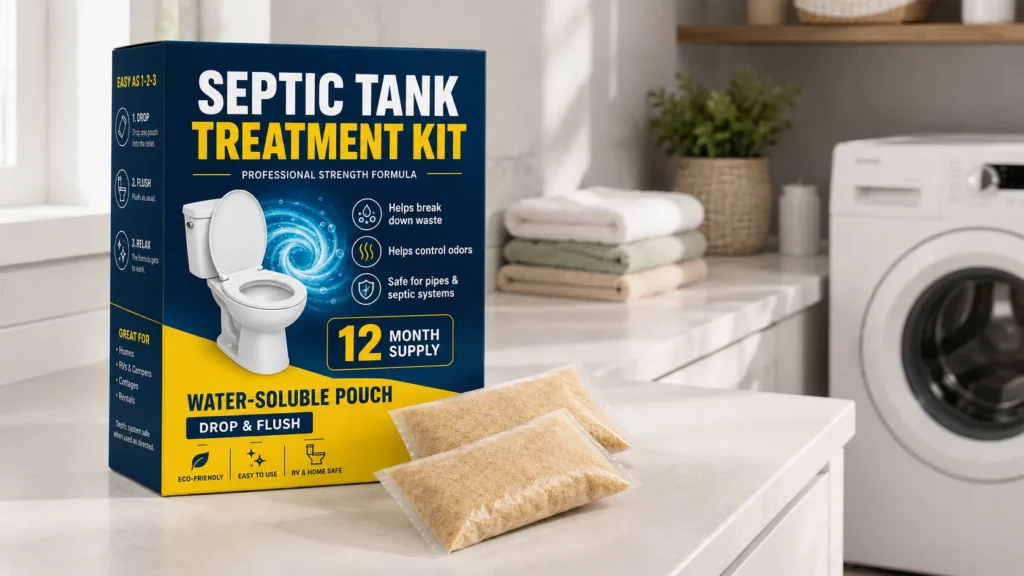
For example, LWASH septic tank treatment packet programs use a pre-measured drop-and-flush format for private-label household septic-care lines. The final label—not a general article or another brand’s instructions—must determine the approved dose, timing, and product claims.
What Is the Best Way to Treat a Septic Tank?
Short answer: The best way to care for a septic tank is regular, system-appropriate maintenance: use water efficiently, keep unsuitable materials out of drains, protect the drainfield, and arrange inspection and pumping on the schedule appropriate for the household and system.
There is no one packet, tablet, or liquid that is “best” for every household. The U.S. Environmental Protection Agency’s septic-maintenance guidance recommends inspecting a typical system every 1–3 years and pumping it every 3–5 years. The actual timing depends on factors such as tank size, household size, water use, solids accumulation, garbage-disposal use, and whether the system includes additional components.
A septic treatment product should therefore never be positioned as a substitute for pumping, inspection, drainfield protection, or a professional response to a malfunction.
Do Septic Tank Treatments Really Work?
Short answer: Do not assume that a septic tank additive is necessary or that it can fix a system problem. EPA states that bacteria- and chemical-based additives are not recommended as a requirement for domestic wastewater treatment because a functioning onsite system already contains microorganisms; some additive products may be ineffective or may harm system operation or the environment.
That is why a trustworthy septic tank treatment article should not promise that a packet will restore a drainfield, prevent backups, eliminate the need for pumping, or repair a failed system. EPA’s Septic Tank Additives Fact Sheet advises homeowners to prioritize efficient water use, proper waste disposal, regular inspection and pumping, and drainfield protection.
For brands, wholesalers, and e-commerce sellers, this is a claim-control issue as much as a product issue. A final label can describe only what the approved product evidence supports. Avoid broad statements such as “restores septic systems,” “prevents all backups,” “replaces pumping,” “works instantly,” or “safe for every system” unless those claims have been properly reviewed and substantiated.
How Often Should I Use a Septic Tank Treatment?
Short answer: Follow the finished product label. There is no universal monthly, quarterly, or annual schedule that applies to every septic tank treatment product or every household system.
Different formats and formulas can have different directions. Do not copy a dosing schedule from a competitor, increase the dose after a missed use, or use a product as a response to a backup without professional advice. A correct product label should state the approved use, dose, frequency, system scope, and warnings for the final formula.
This question is separate from pumping. EPA’s general maintenance guidance is inspection every 1–3 years and pumping every 3–5 years or as needed; local rules and the system professional’s recommendation can be more specific for a particular property. See the EPA’s septic-system FAQs for the factors that affect a pumping schedule.
What Kills Good Bacteria in a Septic Tank, and What Should Never Go Down the Drain?
Short answer: Do not rely on a product to compensate for poor disposal habits. Materials that do not decompose easily and strong or hazardous chemicals can interfere with a septic system and create additional maintenance risk.
EPA advises homeowners not to pour grease, oils, pesticides, drain cleaners, household chemicals, paint, paint thinners, or coffee grounds down drains. It also advises flushing only human waste and toilet paper, rather than wipes, dental floss, diapers, cat litter, paper towels, medications, and similar materials.
- Keep food grease and oils out of drains. They can accumulate in the tank and may contribute to drainfield problems.
- Limit unnecessary solids. Food waste, wipes, paper towels, hygiene products, litter, and similar items are not a substitute for toilet paper and human waste.
- Dispose of chemical and hazardous waste correctly. Do not use a septic system as a disposal route for products that the label or local authority directs elsewhere.
- Use water thoughtfully. Spreading high-water activities over time can reduce stress on a system.
- Protect the drainfield. Keep vehicles, heavy objects, roof runoff, and other inappropriate loads away from the area.
NC State Extension’s septic-system maintenance guidance also explains why grease, hazardous chemicals, and excess solids should be kept out of a septic system and why additives do not replace regular pumping.

Does a Septic Odor Mean the System Is Failing?
Short answer: Not always. An odor can have several causes, so it is not possible to diagnose the exact reason remotely. However, odor near a tank or drainfield should not be ignored when it appears with other warning signs.
EPA lists the following signs that can indicate a failing septic system:
- Water or sewage backing up into household plumbing.
- Very slow drains or gurgling plumbing.
- Standing water or damp areas near the septic tank or drainfield.
- Sewage odors around the tank or drainfield.
- Unusually bright green, spongy grass above the tank or drainfield during dry weather.
If these signs are present, contact a local septic-system service professional or the relevant local authority. A treatment product should not be used as a substitute for diagnosis or repair.
Important: This article is general household septic-system information. Local requirements vary, and septic-system products can be subject to state and local rules. For a suspected system failure, a specific property design question, or a local compliance question, contact a qualified local septic professional or permitting authority.
How Do You Choose Septic Tank Treatment Products? A Private-Label Checklist
Short answer: Confirm the final formula, intended system, directions, warning language, evidence behind product claims, and target-market requirements before approving packaging or production.
- Intended application: Define the approved use precisely. Household septic systems, RV holding tanks, boats, portable toilets, and other sanitation applications should not be treated as automatically interchangeable.
- Directions and limits: Confirm packet weight, dose, frequency, capacity range, use route, storage, and exclusions from the final label and technical documentation.
- Formula and documentation: Review final formula information, SDS/MSDS, test support where relevant, ingredient disclosures, and target-market compliance requirements.
- Claim substantiation: Review every statement about odor, waste breakdown, sludge, bacteria, system compatibility, safety, sustainability, or maintenance outcomes before it is printed or published.
- Packaging: Approve the retail box, packet count, label language, warning panel, barcode, carton marks, and country-specific requirements using the final approved artwork.
To discuss a pre-measured packet format, private-label packaging, and documentation requirements, review the LWASH septic tank treatment packet product page or contact the LWASH team with the target market and packaging brief.
More Septic Tank Treatment FAQs
What does septic tank treatment do?
“Septic tank treatment” describes a category of products sold in formats such as packets, tablets, liquids, or additives. It does not describe one universal formula or one guaranteed outcome. The approved use, dose, claims, and limitations must come from the finished product label.
Can septic tank treatment replace pumping?
No. Pumping removes accumulated sludge and scum; it is part of professional system maintenance. A treatment product is not a replacement for inspection, pumping, drainfield care, or repair.
Can I use too much septic tank treatment?
Do not guess or exceed the finished label directions. More product is not automatically better, and an unapproved dose may not be appropriate for the formula or system. If the system has a problem, seek professional assessment instead of increasing the dose.
Can septic tank treatment solve a septic smell?
Do not assume so. A septic odor can have several causes, including venting or a drainfield issue, and it cannot be diagnosed from odor alone. If odor occurs with slow drains, backups, standing water, or wet ground near the system, contact a local professional rather than relying on a product.
What is the worst thing for a septic tank?
There is no single answer for every property, but poor disposal habits and neglected maintenance create avoidable risk. Keep inappropriate solids, grease, oils, chemicals, and hazardous waste out of the system, use water efficiently, and follow the property’s maintenance schedule.
Can I use a household septic treatment in an RV or boat?
Do not assume so. Household septic systems and mobile holding tanks have different conditions, capacities, maintenance needs, and label requirements. Use only a product whose final label specifically approves the intended application.
How do I know when a septic tank needs service?
Keep inspection and pumping records, follow the schedule recommended for the property, and act promptly if there are backups, very slow drains, gurgling, standing water, sewage odor near the system, or unusually lush wet ground above the tank or drainfield.
Building a private-label septic-care range? Start with the target market, intended application, final claim scope, packaging requirements, and approved label directions. Contact LWASH to discuss a septic tank treatment packet project.