
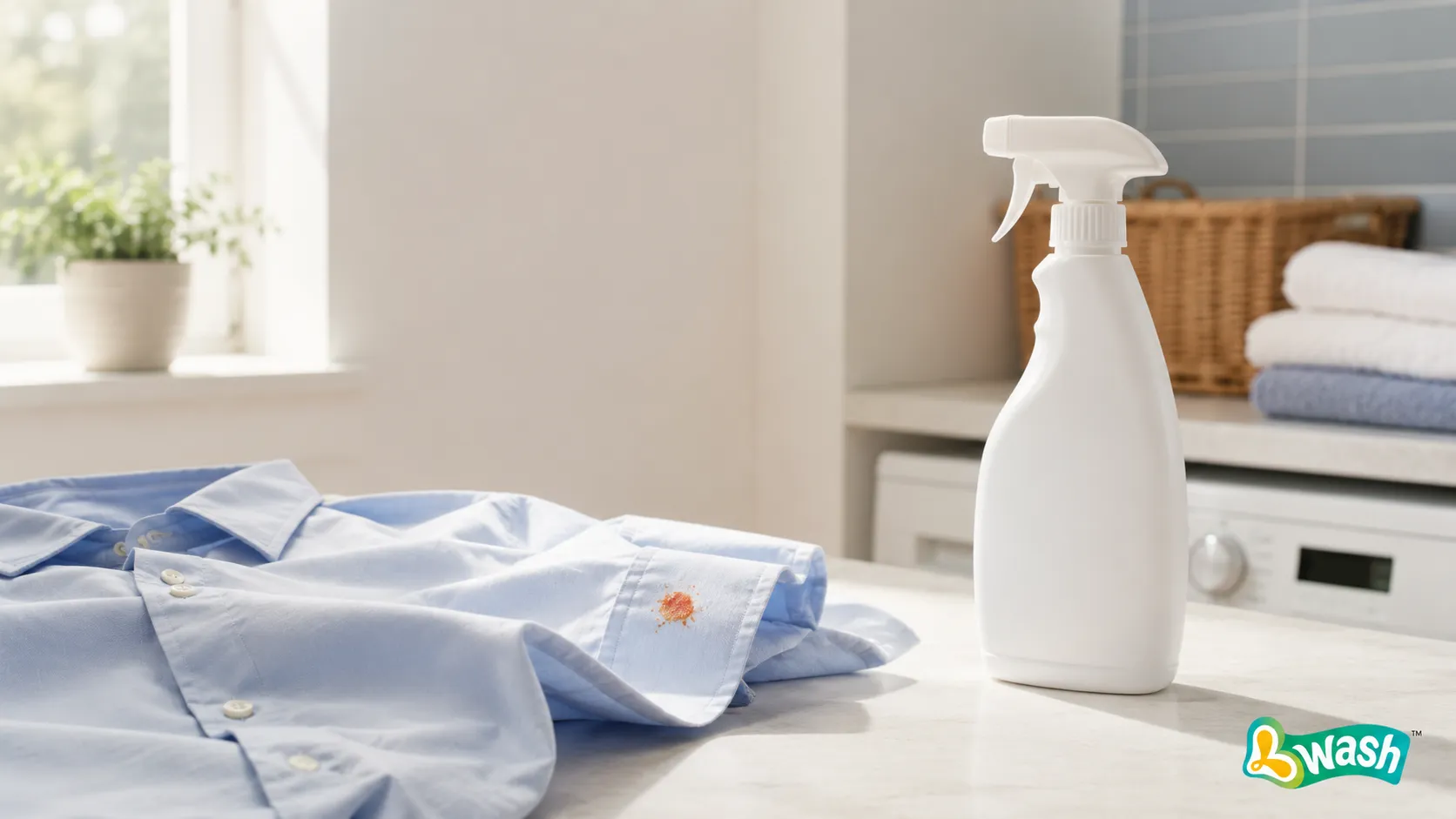
A stain remover spray is a spot pre-treatment used on a stained area before the garment is washed. It can be useful when the formula, fabric, stain type, and finished-label directions are a good match. It is not a universal answer for every fabric, every old stain, or every surface.
This guide explains how to use a stain remover spray on clothes, what can affect the result, and what private-label buyers should verify before approving a laundry stain-treatment product.
Quick Answers About Stain Remover Spray
| Question | Short answer |
|---|---|
| What is stain remover spray used for? | It is typically used to pre-treat a stained spot on a washable garment before laundering. The exact product label controls the approved fabrics, dose, and waiting time. |
| Does stain remover spray work? | It can help as part of a correct pre-treatment and wash process. Results vary with the stain, how long it has set, the fabric, the formula, and the care-label directions. |
| How do you use stain remover spray on clothes? | Read the product and garment labels, test a hidden area when directed, apply only as labeled, then wash the full garment according to its care instructions. |
| Can it remove old stains? | Older stains are often harder to remove. A repeat treatment may be needed, but do not dry the garment while a stain remains because drying can make removal more difficult. |
| Can one spray be used on every fabric? | No. Do not assume that a laundry spray is approved for every dye, fiber, trim, finish, baby garment, carpet, upholstery, car interior, or hard surface. |
In this guide
- What a stain remover spray is
- How to use it on clothes
- What affects stain-removal results
- What to avoid
- What private-label buyers should check
- More frequently asked questions
What Is a Stain Remover Spray?
Short answer: A stain remover spray is a liquid pre-treatment format that is applied to a spot or soiled area before the garment is laundered.
It is different from a full-load laundry detergent. A spray is designed for targeted pre-treatment, while detergent is used in the wash process for the complete garment or load. The American Cleaning Institute’s laundry guidance recommends identifying the stain when possible, treating it promptly, and following the garment’s fabric-care instructions.
LWASH stain remover spray programs are designed for laundry and fabric spot pre-treatment before washing. The current format is a 120ml spray bottle; the final formula, approved fabric compatibility, directions, warnings, and claims must be confirmed for each product project.
How Do You Use Stain Remover Spray on Clothes?
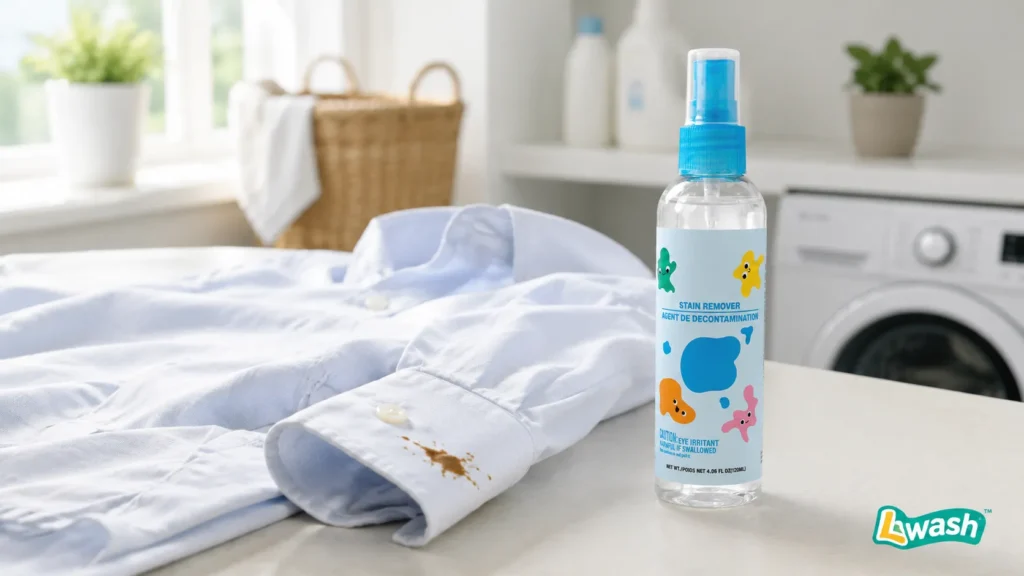
Short answer: Follow the finished product label and the garment care label. A reliable routine is to address the spot promptly, use only the labeled application method, wash the full garment, and inspect it before drying.
- Check both labels first. Confirm that the garment is washable and that the stain remover is approved for that fabric, dye, trim, and intended use.
- Act before the stain sets when possible. Remove loose residue carefully and blot rather than aggressively rubbing the stained area.
- Test an inconspicuous area if the label directs it. A hidden seam can help show whether the color or finish reacts poorly before the visible spot is treated.
- Apply only the labeled amount and method. Do not copy another brand’s waiting time, mix cleaning products, or assume more product will work better.
- Launder the complete garment. Use the wash cycle and temperature allowed by the garment care label.
- Inspect before putting the item in a dryer. If the stain remains, follow the product label for the next step rather than using heat to finish the garment.
The American Cleaning Institute’s stain-removal guide similarly emphasizes prompt treatment, pre-treatment before laundering, and checking that a stain is gone before drying. Exact directions still depend on the finished product and the fabric-care label.
What Affects Whether a Stain Remover Spray Works?
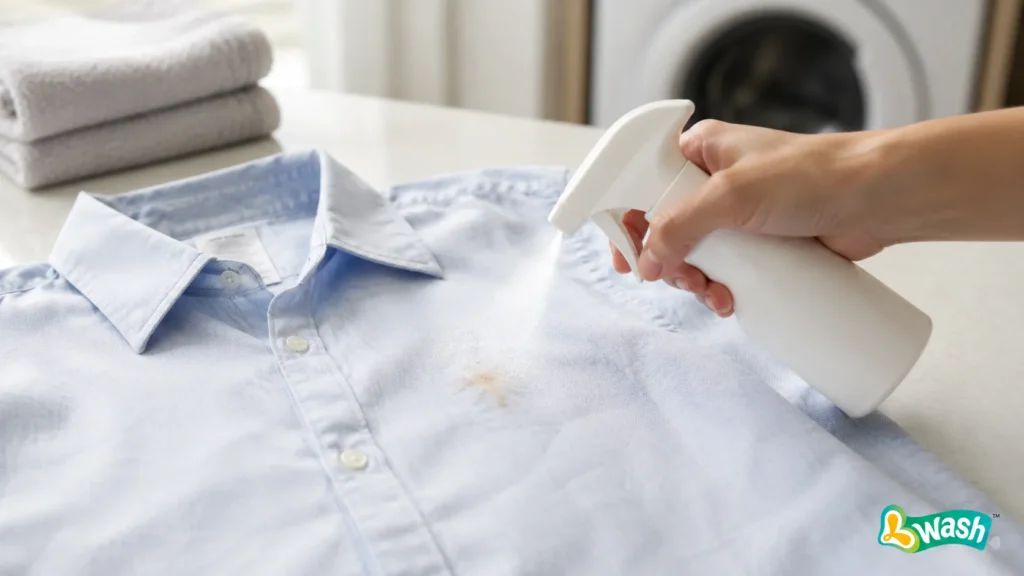
Short answer: The result depends on more than the spray itself. Stain source, stain age, fabric type, colorfastness, the approved formula, application time, and the wash process all matter.
- Stain type: Food, oil, makeup, grass, ink, blood, and dye transfer do not behave the same way. Identifying the source can help determine a suitable treatment.
- How long the stain has been present: Fresh stains are generally easier to address. Older stains may need more than one label-approved treatment.
- Fabric and color: Fibers, dyes, finishes, embellishments, and trims can react differently. A white garment is not automatically suitable for every stain-removal method.
- Heat: Drying a garment while the stain is still visible can make subsequent removal more difficult.
- Label compatibility: A spray should be used only for the materials and use conditions that its finished label supports.
For stain-specific laundering advice, Tide’s stain-removal guide also distinguishes between stain sources and directs users back to the garment’s fabric-care label for wash temperature and cycle selection.
What Should You Avoid When Using a Stain Remover Spray?
Short answer: Avoid treating a laundry pre-treatment spray as a universal cleaner or a guarantee that every stain will disappear.
- Do not use it on a fabric, surface, or item that the final label does not approve.
- Do not assume a clothes spray is appropriate for carpets, upholstery, cars, furniture, kitchens, or every baby garment.
- Do not leave the product on longer than the label allows, especially when the dye, finish, or fiber compatibility has not been confirmed.
- Do not mix cleaning products or add bleach, solvents, acids, or other treatments unless their labels specifically permit that combination.
- Do not promise that any one product is the “best” option for every stain. The right method depends on the stain and the garment.
- Do not dry the garment until the visible stain has been checked; repeat a label-approved process if needed.
Important: This article provides general laundry guidance, not a substitute for the finished product label or garment-care label. Formulas and fabrics differ. If a garment has a special-care instruction or an unknown dye or finish, follow the care label or consult a professional cleaner.
What Should Private-Label Buyers Confirm Before Sourcing a Stain Remover Spray?
Short answer: Confirm the final formula, supported fabrics and stains, use directions, warning content, and evidence behind every package claim before approving artwork or production.
- Use position: Define whether the product is a spot pre-treatment before washing, an on-the-go treatment, or another approved laundry-care use. Do not combine different product roles without evidence.
- Fabric and stain scope: Confirm which materials, colors, dyes, trims, and stain categories the final formula is approved to address. Specify any exclusions clearly.
- Directions: Approve dose, spray distance, contact time, testing instruction, laundering step, and any rinse or storage direction from final product documentation.
- Claims: Validate statements such as “works on old stains,” “color safe,” “for baby clothes,” “for carpets,” “non-toxic,” or “eco-friendly” before they appear on a label or website.
- Packaging: Confirm the 120ml bottle, sprayer, label language, warning panel, barcode, carton, and target-market requirements with final samples.
For an OEM or private-label project, buyers can review the LWASH 120ml stain remover spray format and then confirm formula direction, packaging, approved claims, and target-market documentation before sampling.
More Stain Remover Spray FAQs
Does stain remover spray work on old stains?
It may help, but old stains are often more difficult to remove than fresh ones. Follow the finished product label, wash the item as its care label permits, and inspect it before drying. Do not promise complete removal from every old stain.
What happens if stain remover is left on too long?
The answer depends on the formula and fabric. Leaving a product on beyond its label directions can create unnecessary risk for dyes, finishes, or fibers. Use only the approved contact time and test an inconspicuous area where the label advises.
Can I use stain remover spray on white clothes?
Only if the finished product label and the garment’s care label allow it. “White” does not identify the fiber, dye treatment, trim, or finish, so it is not a substitute for checking label compatibility.
Can I use a laundry stain remover spray on baby clothes?
Only when the exact finished product is labeled and supported for that use. Do not infer baby-clothes suitability from a general laundry or fabric-care description.
Can vinegar replace a stain remover spray?
Vinegar is a separate household ingredient, not a universal substitute for a labeled stain-removal product. Do not mix it with other cleaning products or use it as a replacement for product directions without checking garment and product guidance.
Can I use a stain remover spray on carpets, furniture, or in a car?
Not unless the exact label approves that surface. A spray designed for washable laundry pre-treatment should not be treated as a carpet, upholstery, vehicle, or hard-surface cleaner.
Developing a private-label laundry-care range? Explore the LWASH stain remover spray product format and confirm formula, label directions, testing, and packaging requirements before production.