
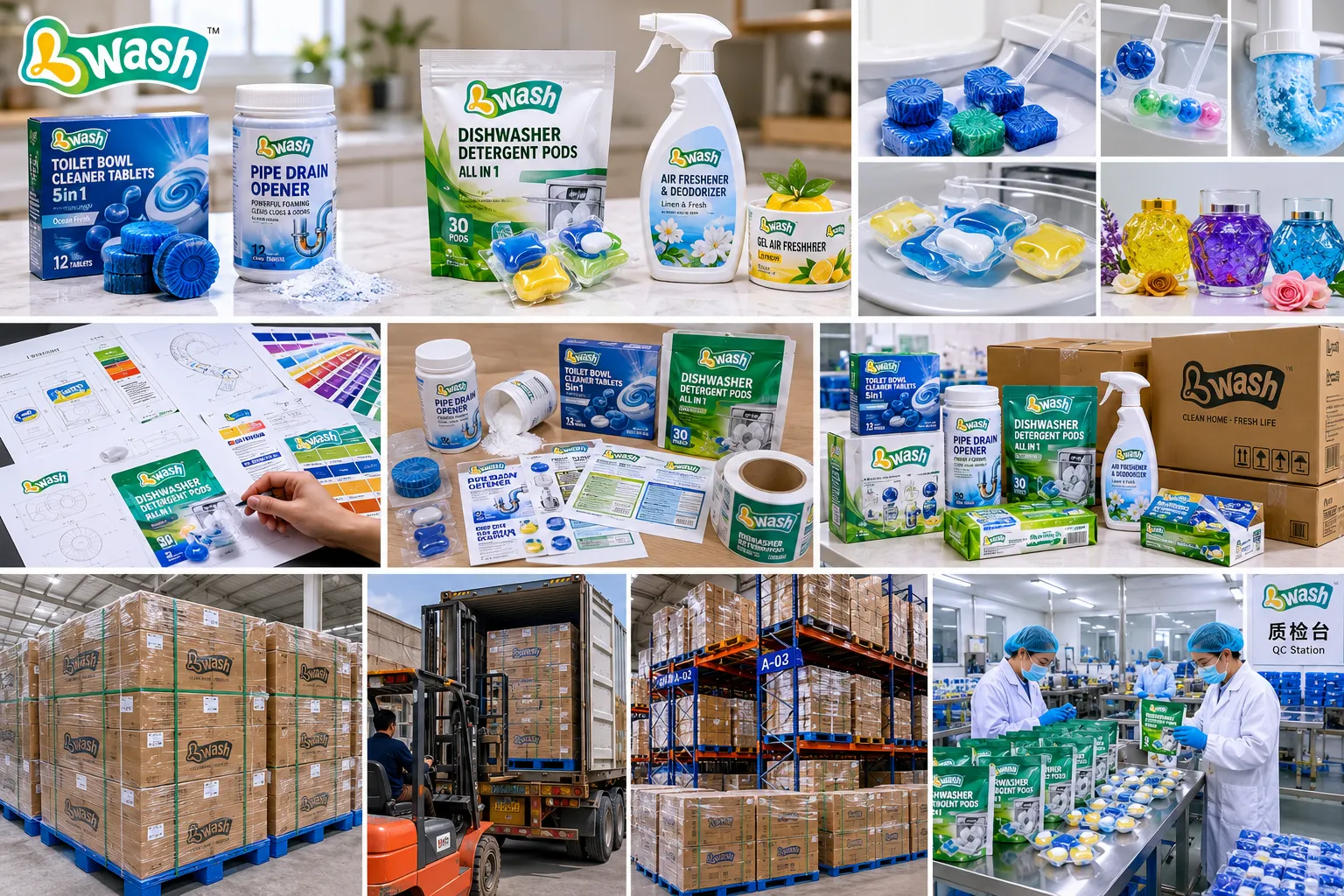
A household cleaner manufacturer can help B2B buyers develop, produce, package, and supply cleaning products for retail, wholesale, e-commerce, and private label channels.
But choosing the right manufacturer is not only about finding the lowest price. A good supplier should understand product categories, packaging formats, quality control, export requirements, usage instructions, and realistic product claims.
For buyers who are sourcing private label household cleaners, the right question is not simply “Which manufacturer is the biggest?” It is “Which manufacturer can support my target market, product range, packaging needs, order quantity, and long-term sales plan?”
This guide explains what to check before contacting a household cleaner manufacturer, especially if you are sourcing products such as toilet cleaner tablets, drain cleaner, dishwasher detergent, bathroom deodorizer, home fragrance, or other household cleaning products.
What Does a Household Cleaner Manufacturer Do?
A household cleaner manufacturer produces cleaning and home care products for household, retail, wholesale, commercial, and private label use.
Depending on the factory and product category, a manufacturer may support:
- product development
- existing formula selection
- OEM or ODM production
- private label packaging
- bottle, pouch, carton, tablet, powder, gel, or block formats
- label and carton customization
- sample preparation
- batch production
- quality control
- export packing
- shipping document coordination
Some buyers only need ready product options with their own label. Others need a more customized product form, fragrance direction, package size, carton design, or retail display format.
This is why the best supplier is not always the one with the longest product list. The better choice is often the manufacturer that can match your sales channel and explain the product clearly enough for your customers.
Common Household Cleaning Products Buyers Source From Manufacturers
Household cleaning products can cover many categories. For B2B sourcing, buyers usually focus on products that are easy to position, easy to package, and easy to explain on shelves or online product pages.
Common categories include:
- toilet cleaner tablets
- toilet blue blocks
- drain cleaner
- dishwasher detergent
- kitchen cleaning products
- bathroom deodorizer
- home fragrance products
- surface cleaning products
- cleaning tablets, powders, gels, liquids, and blocks
For example, a retailer may want a small household cleaning range for bathroom and kitchen shelves. An e-commerce seller may focus on lightweight packaging and clear product photos. A private label brand may need a more complete product line with matching packaging style across several SKUs.
A manufacturer that understands multiple product types can help buyers plan a cleaner product structure instead of sourcing each item separately from unrelated suppliers.
Manufacturer, Supplier, Private Label, OEM, and ODM: What Is the Difference?
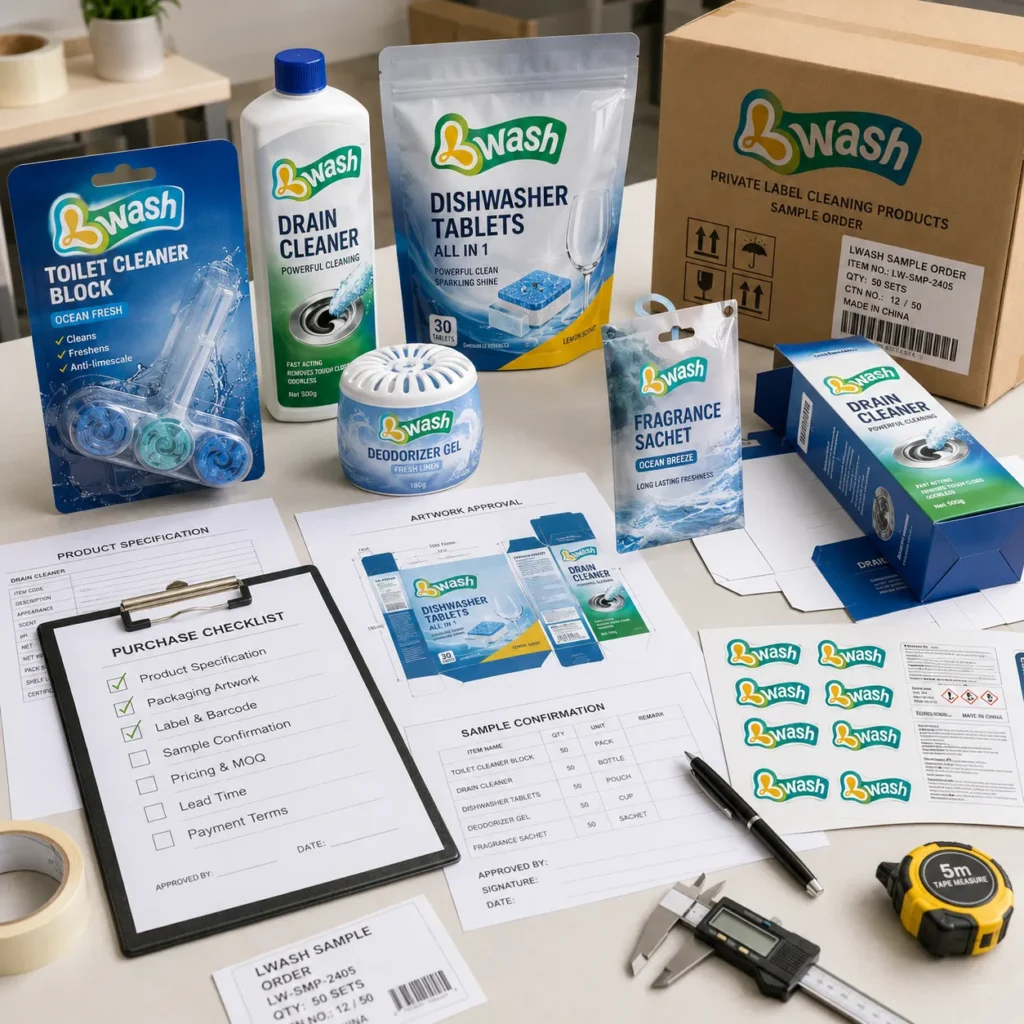
These terms often appear together in search results, but they do not always mean the same thing.
A manufacturer is usually responsible for production. A supplier may be a manufacturer, trading company, distributor, or sourcing partner. A private label manufacturer produces products that can be sold under the buyer’s own brand. OEM usually means the product is made according to the buyer’s requirements. ODM usually means the factory can provide existing product development options or product concepts that buyers can adapt.
In real sourcing conversations, buyers should ask direct questions:
- Are you the manufacturer or a trading company?
- Which product categories do you produce in-house?
- Do you support private label packaging?
- Do you have existing product options for faster sampling?
- Can you support customized packaging sizes or label designs?
- What is the MOQ for each product and package type?
- What quality checks are done before shipment?
- Can you support export packing and documents?
Clear answers to these questions can save time before sampling.
How to Compare Household Cleaner Manufacturers
When comparing household cleaner manufacturers, buyers should look beyond the product catalog. The real value is in how well the supplier can support your product plan from sample to shipment.
1. Product Range
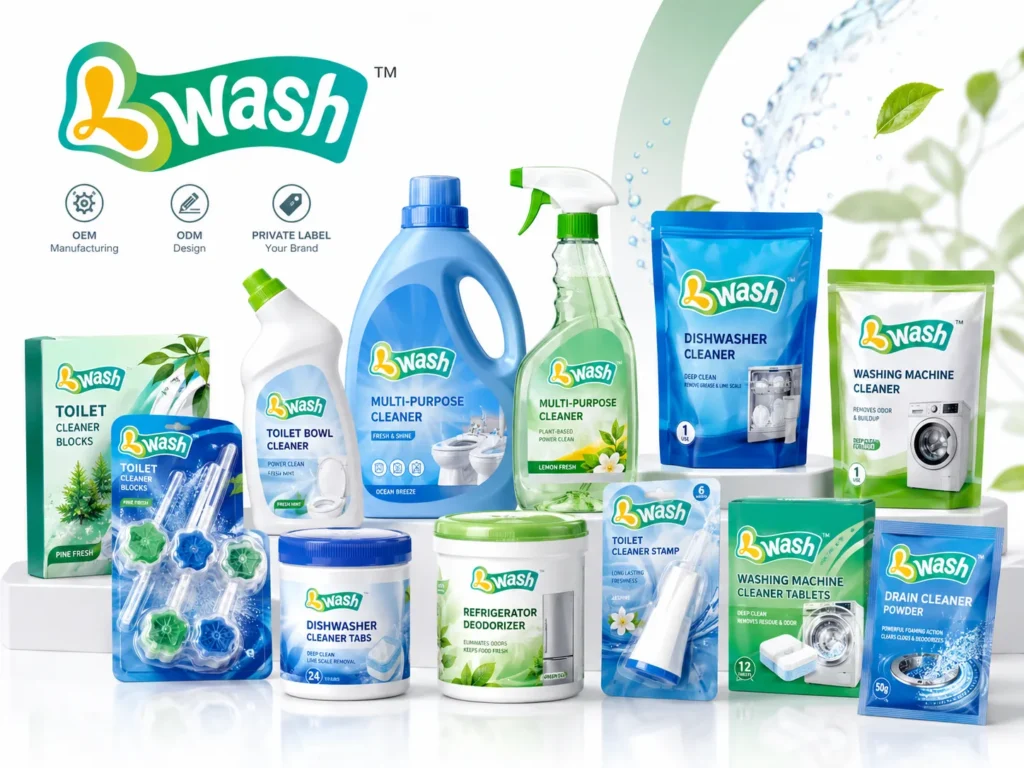
Start with the product categories you want to sell.
If you are building a bathroom cleaning range, you may need toilet cleaner tablets, bathroom deodorizer, drain cleaner, and related fragrance products. If you are building a kitchen cleaning range, dishwasher detergent and kitchen cleaning products may be more important.
Ask whether the manufacturer can support a connected product line. This can make packaging, branding, carton planning, and reorder management easier.
2. Product Form and Packaging
Cleaning products can come in many forms, including tablets, blocks, powders, gels, liquids, pouches, bottles, cartons, and display boxes.
Different channels need different packaging decisions:
- retail buyers may care about shelf display and barcode placement
- e-commerce sellers may care about leakage risk, outer packaging, and shipping weight
- wholesalers may care about carton quantity and pallet efficiency
- brand owners may care about label design and product line consistency
Before choosing a manufacturer, ask what packaging formats are already available and which ones need new development.
3. Private Label and Customization Support
Private label cleaning products need more than a logo on a label.
Buyers should prepare:
- target market
- sales channel
- expected product form
- package size
- label language
- warning and usage direction requirements
- fragrance or color preference, if relevant
- estimated order quantity
- reference packaging style
- target retail price or cost range
The more clearly you prepare these details, the easier it is for the manufacturer to recommend suitable product and packaging options.
4. MOQ, Lead Time, and Reorder Stability
MOQ is important, but it should not be reviewed alone. A very low MOQ may not always match customized packaging, stable production, or future reorder plans.
Ask the manufacturer:
- What is the MOQ for standard packaging?
- What is the MOQ for private label packaging?
- Does customized packaging require a separate MOQ?
- How long does sampling usually take?
- How long does production take after order confirmation?
- Can the supplier support repeat orders with stable packaging and specifications?
For B2B buyers, stable repeat supply is often more important than a one-time sample.
5. Quality Control and Product Documentation
A good household cleaner manufacturer should be able to explain how quality is managed before shipment.
Depending on the product type and target market, buyers may need to discuss:
- product appearance checks
- package sealing checks
- carton and outer packing checks
- batch consistency
- storage reminders
- usage directions
- product photos
- label files
- basic product documentation
- target market requirements
Do not wait until the shipment stage to discuss these items. They should be part of the early sourcing conversation.
6. Realistic Claims and Compliance Awareness
Cleaning product wording matters, especially for overseas markets.
Avoid using broad or unsupported claims such as “non-toxic,” “eco-friendly,” “biodegradable,” “disinfect,” “kill bacteria,” “antibacterial,” “safe for all pipes,” or “harmless” unless the product has proper evidence and the claim is suitable for the target market.
Many product pages lose trust because they promise too much. A better strategy is to explain the product’s actual use scenario, usage method, packaging, and buyer support clearly.
For example:
- toilet cleaner tablets can be positioned around regular toilet maintenance and user experience
- drain cleaner can be positioned around suitable blockage scenarios and usage boundaries
- dishwasher detergent can be positioned around machine-use scenarios, dosage, and controlled foam
- bathroom deodorizer can be positioned around odor management and refill convenience
- home fragrance can be positioned around space size, fragrance preference, and packaging format
Practical wording is usually safer and more useful for buyers than exaggerated claims.
Should Buyers Trust “Top 10 Household Cleaner Manufacturers” Lists?
Top 10 household cleaner manufacturer lists can be useful for early research, but they should not be the only basis for supplier selection.
These lists may help you discover company names, product categories, and common market positioning. However, a ranking page cannot tell you whether a supplier fits your exact product, packaging, MOQ, target market, communication style, and reorder plan.
Use Top 10 lists as a starting point, then build your own supplier comparison table.
Useful comparison fields include:
- product categories
- private label support
- packaging options
- MOQ
- sampling time
- lead time
- export experience
- product documentation
- claim wording support
- response speed
- ability to support repeat orders
If you are sourcing for a serious retail, wholesale, or private label project, your own checklist is more important than someone else’s ranking.
What Buyers Should Prepare Before Contacting a Household Cleaner Manufacturer
Before you contact a household cleaner manufacturer, prepare a short sourcing brief. This helps the supplier respond faster and reduces misunderstandings.
Your brief can include:
- target country or region
- sales channel
- product category
- desired product form
- package size
- expected order quantity
- private label or standard packaging requirement
- label language
- product photos or packaging references
- target launch date
- key customer concerns
- shipping preference, if already known
Here is a simple example:
“We are looking for private label toilet cleaner tablets and drain cleaner for e-commerce sales in our market. We need small retail packaging, English label support, clear usage instructions, and carton packing suitable for shipping. Please share available product options, MOQ, sample cost, production lead time, and packaging choices.”
A message like this is much easier for a manufacturer to answer than a general question such as “Please send price.”
Buyer Checklist: How to Choose the Right Household Cleaner Manufacturer
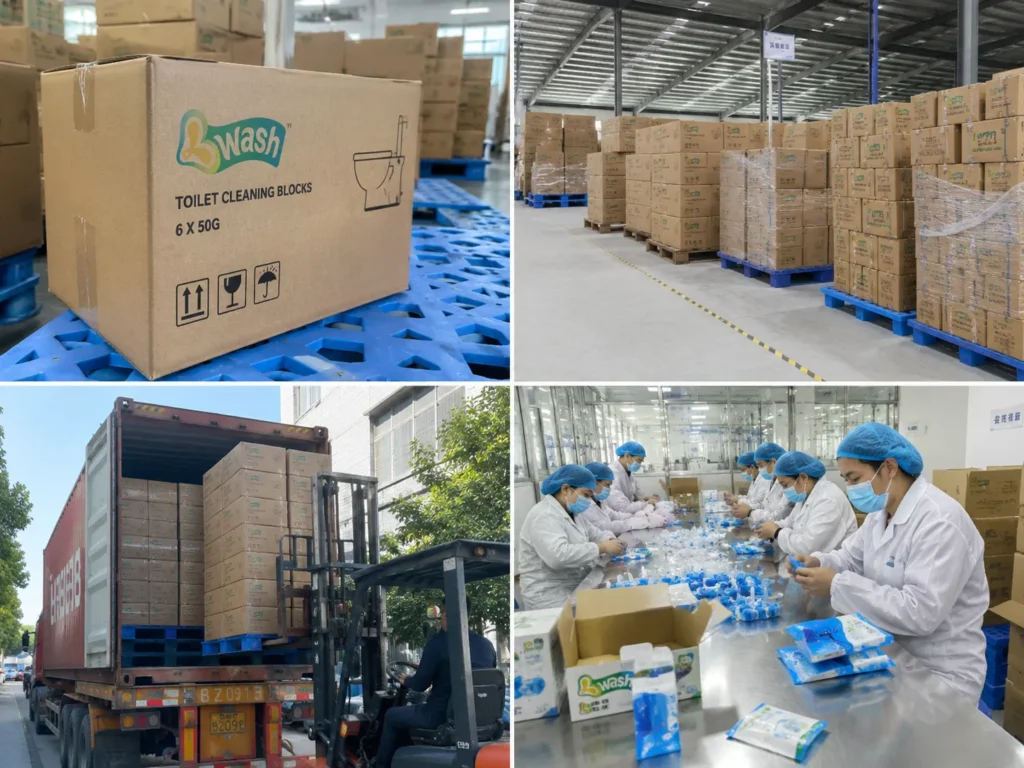
Use this checklist before moving from first contact to sampling:
- Does the manufacturer produce the product category you need?
- Can they support private label or OEM/ODM requirements?
- Are the available product forms suitable for your sales channel?
- Is the MOQ realistic for your launch plan?
- Are packaging options clear?
- Can the supplier explain usage directions and product boundaries?
- Are product claims practical and supported?
- Is the sample process clear?
- Is the lead time clear?
- Can the manufacturer support repeat orders?
- Are communication and documents professional enough for overseas business?
If most answers are unclear, slow, or inconsistent, the supplier may not be the best fit for your project.
Conclusion
Choosing a household cleaner manufacturer is not only about finding a factory that can make cleaning products. It is about finding a supplier that understands your product category, packaging needs, private label plan, target market, and long-term sales channel.
For B2B buyers, a strong manufacturer should help you compare product forms, prepare samples, plan packaging, avoid unclear claims, and build a product line that is easier to sell and reorder.
If you are sourcing toilet cleaner tablets, drain cleaner, dishwasher detergent, bathroom deodorizer, home fragrance, or other private label household cleaning products, we can share available product options, packaging choices, sample information, and OEM/ODM support.
Contact us to discuss your household cleaning product sourcing plan.
FAQ
What is a household cleaner manufacturer?
A household cleaner manufacturer produces cleaning and home care products for household, retail, wholesale, e-commerce, and private label channels. Depending on the factory, this may include product production, packaging, labeling, sampling, quality control, and export support.
What products are included in household cleaning products?
Household cleaning products may include toilet cleaner tablets, drain cleaner, dishwasher detergent, kitchen cleaning products, bathroom deodorizer, surface cleaners, home fragrance products, and other products used for home cleaning or maintenance.
What is a private label cleaning products manufacturer?
A private label cleaning products manufacturer produces cleaning products that buyers can sell under their own brand name. The manufacturer may support custom labels, packaging formats, product forms, carton designs, and OEM/ODM options.
How do I choose a cleaning product manufacturer?
Compare the manufacturer’s product range, private label support, packaging options, MOQ, sample process, production lead time, quality control, export experience, and claim wording awareness. The right supplier should match your product category and sales channel.
What should buyers prepare before requesting samples?
Buyers should prepare the target market, product category, sales channel, package size, label language, expected quantity, private label needs, packaging reference, and target launch schedule. A clear sourcing brief helps the manufacturer recommend suitable options.
Are Top 10 household cleaner manufacturer lists reliable?
Top lists can help buyers discover possible suppliers, but they should not be the only decision tool. Buyers still need to compare product fit, MOQ, packaging, sample quality, communication, export support, and repeat order stability.
Can household cleaner products use eco-friendly or non-toxic claims?
Use these claims carefully. Broad claims such as “eco-friendly” or “non-toxic” may need proper evidence and must match the rules of the target market. If support is unclear, it is safer to describe specific product features and usage instructions instead.
Can a manufacturer support several household cleaning products in one private label line?
Some manufacturers can support several related products, such as toilet cleaner tablets, drain cleaner, dishwasher detergent, bathroom deodorizer, and home fragrance. Buyers should confirm which products are produced in-house and which packaging options are available.