
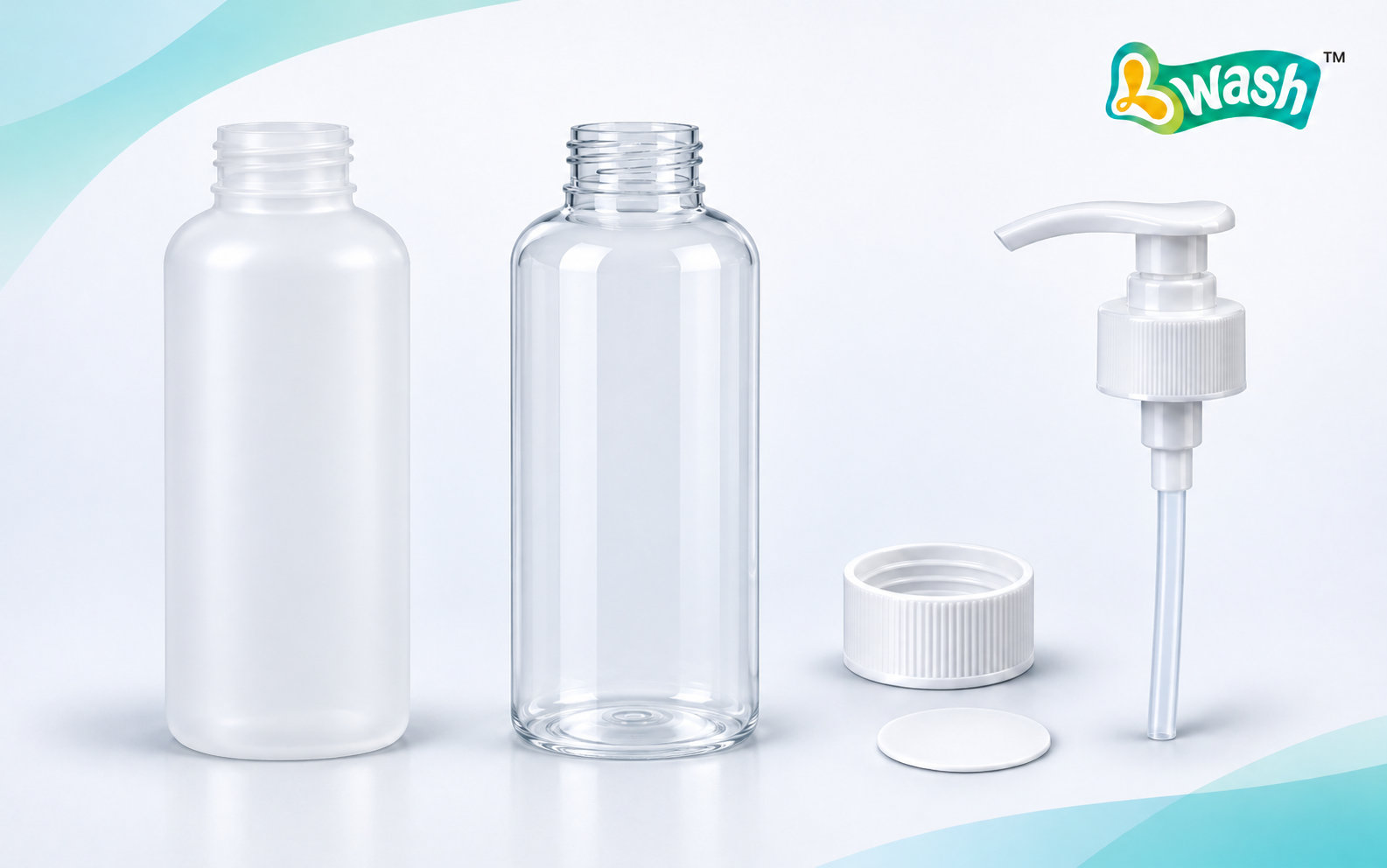
HDPE vs PET bottles for cleaning products: HDPE is often the first material to assess for chemically demanding formulas; PET can be a good candidate when a compatible formula benefits from clear packaging. Both require validation with the actual cleaner, bottle and closure.
For private label buyers, the decision also affects how the product pours, squeezes or sprays, how it survives distribution, and what can accurately be said about recycling. A clear bottle and a white bottle may look like simple alternatives, but their appearance tells you little about how a finished cleaner will behave during storage.
HDPE vs PET Bottles at a Glance
| What to compare | HDPE bottles | PET bottles |
|---|---|---|
| Material | High-density polyethylene, part of the polyethylene family | Polyethylene terephthalate, a polyester |
| Typical appearance | Natural HDPE is milky and translucent; pigments can produce opaque colors | Commonly clear, making the product visible |
| Handling | Semi-rigid; bottle design can support squeeze dispensing | A clear, relatively rigid presentation; handling still depends on bottle design |
| Formula screening | Often a useful candidate for alkaline and other demanding cleaners | Can suit compatible detergent formulas; alkalis and oxidizers need particular attention |
| Light protection | Depends on the color and packaging specification | Clear PET provides limited protection for light-sensitive contents |
| Approval requirement | Test the selected resin grade, bottle and closure with the finished formula | Test the selected resin grade, bottle and closure with the finished formula |
Thermo Fisher Scientific’s HDPE material guide describes natural HDPE as translucent and semi-rigid, with broad resistance to many chemicals. It also identifies limitations involving strong oxidizers and certain solvents.
Which Material Fits Your Cleaning Formula?
Start with the complete formula and expected exposure conditions. Product category and pH are useful starting information, but neither describes every ingredient that will contact the packaging.
Corning’s chemical resistance comparison of PET and PETG gives PET a more favorable general rating for detergents and surfactants than for inorganic alkalis or oxidizing agents. This means PET should be assessed for the particular cleaner rather than rejected for every cleaning application. The note identifies concentration, temperature, exposure time and mechanical load as factors affecting compatibility.
For a packaging brief, separate these situations:
- Water-based detergents and mild cleaners: assess both materials against the actual blend, including fragrance and any solvents. A detergent rating does not approve every finished formulation.
- Strong alkaline cleaners and degreasers: give the chemical-resistance assessment priority over a preference for clear packaging. HDPE is often a sensible candidate to investigate first.
- Bleach and other oxidizing cleaners: confirm the specific oxidizer, concentration, resin grade and closure requirements. Long-term oxidizer exposure can also affect HDPE.
- Solvent-containing cleaners: identify the solvents and their concentrations explicitly. The term “chemical-resistant bottle” is too broad to establish suitability.
PET and PETG must also be kept distinct when requesting material data. A compatibility result for one is not automatically evidence for the other.
Why Can an HDPE Detergent Bottle Still Crack?
HDPE can develop environmental stress cracking when chemical exposure combines with stress in the plastic. This helps explain why general chemical resistance and satisfactory performance in an empty-bottle inspection are not enough to approve a detergent pack.
ASTM International’s D1693 test method addresses environmental stress cracking of ethylene plastics. Its public scope identifies soaps, wetting agents, oils and detergents as environments in which cracking can occur under stress. The standard also notes that stress levels and a material’s thermal history affect results.
Ask the packaging supplier to identify the proposed resin grade and provide relevant environmental stress crack resistance, or ESCR, information. Compare results obtained under equivalent test conditions. A supplier’s reported number of test hours should be read together with the test method, reagent, temperature and specimen preparation.
For the finished product, include filled-bottle storage, closure application and distribution handling in the evaluation. If cracks appear, investigate the resin, molding conditions, bottle geometry and chemical exposure together before approving a revised pack.
Match Bottle Clarity to the Product’s Storage Needs
Clear packaging is useful when seeing the liquid supports product presentation, but it must still provide the protection the formula needs.
The OECD’s case study on detergent bottles discusses HDPE and PET among detergent-packaging options and explains the trade-off between transparency, light protection and recycling design. Natural translucent HDPE should not be treated as automatically protective against UV exposure; an opaque appearance or protective feature must be specified and evaluated.
For a light-sensitive product, define acceptable changes in color, odor and product performance during storage. Review the proposed bottle color, label coverage and storage conditions with the formula and packaging suppliers. Increasing label coverage or adding a protective feature can also affect sorting and recycling, so review the complete design before approving the artwork.
Choose the Bottle and Dispenser Together
A compatible bottle needs a compatible closure, liner and dispensing system. A leak or dispensing failure may originate in a component other than the bottle wall.
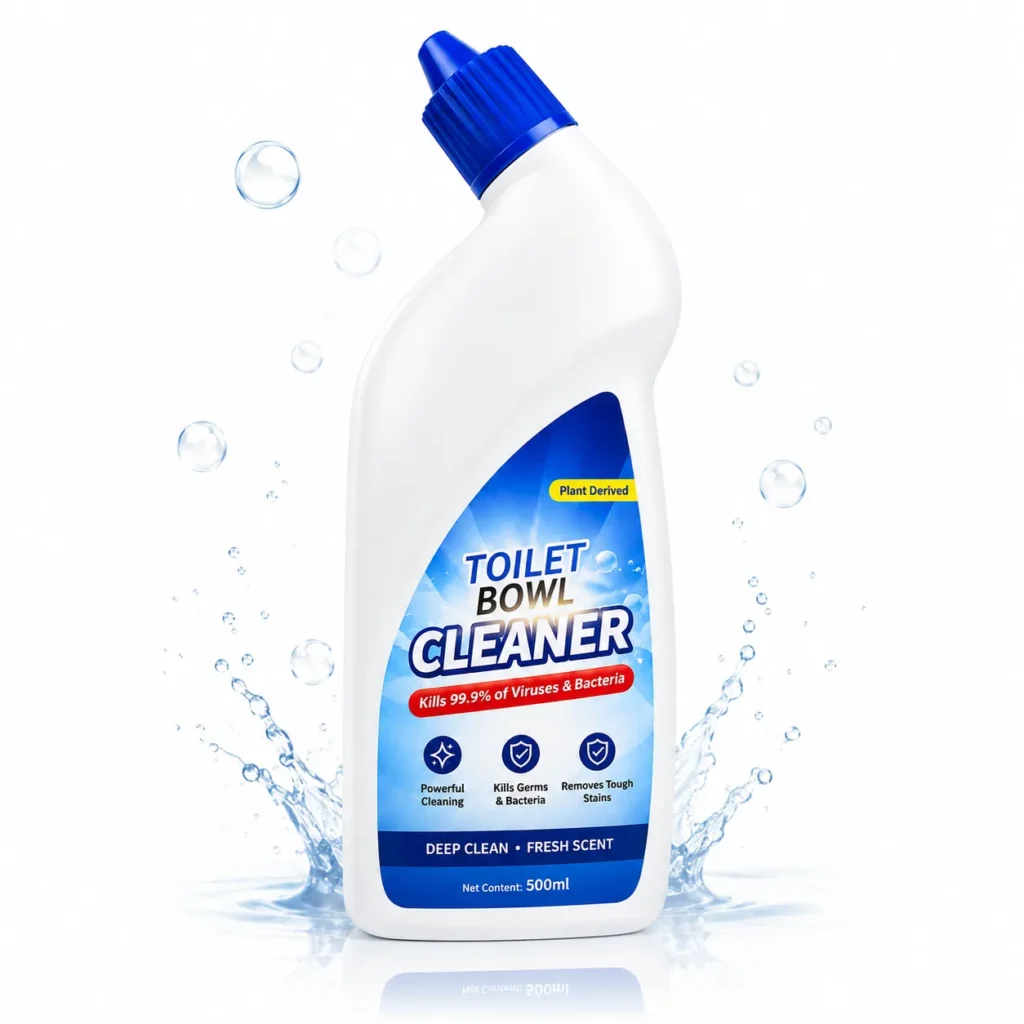
An angled squeeze format, such as the packaging shown for LWASH’s liquid toilet bowl cleaner, needs to be assessed for grip, controlled dispensing, cap sealing and recovery after squeezing. Confirm the resin grade and bottle dimensions alongside the dispensing design.
For a product such as LWASH’s stain remover spray, check the pump, dip tube, seals and spray performance with the filled product. Evaluate dispensing again after storage and repeated use. An attractive bottle-and-pump combination is ready for production only when the complete assembly performs as required.
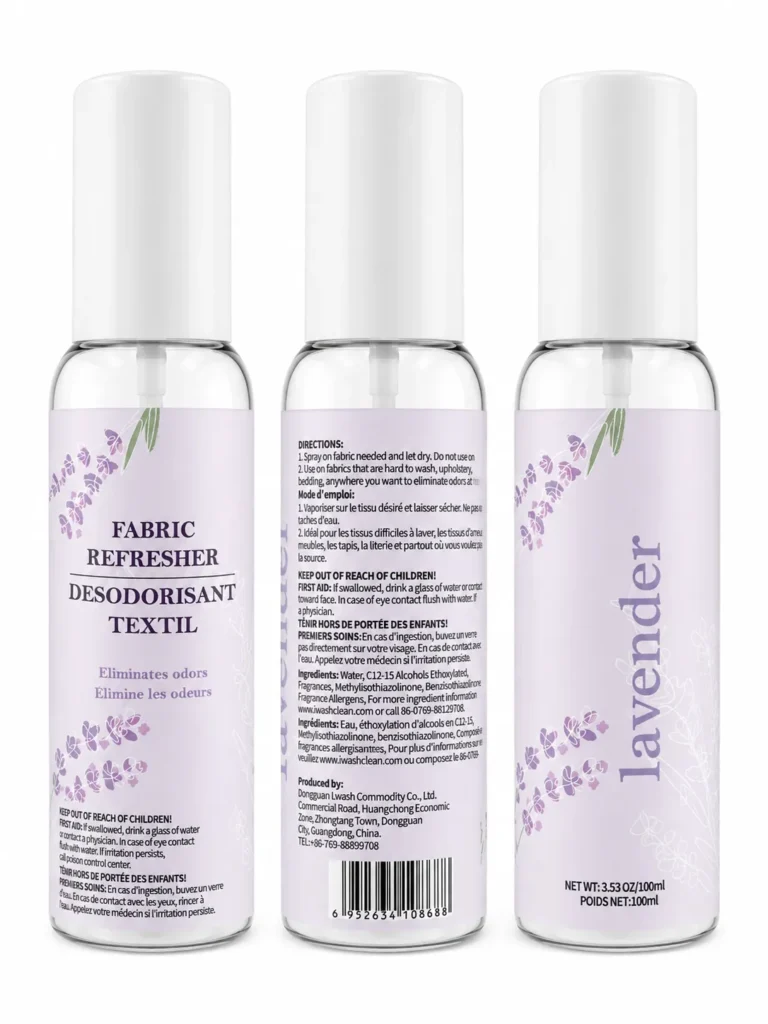
For either format, confirm the neck finish, closure application settings, fill volume and label area before approving samples. Evaluate any required child-resistant closure as part of the final package.
Compare the Cost of a Finished Pack
Compare quotations for the same usable packaging specification. Resin price alone does not determine the cost of an HDPE or PET cleaning-product bottle.
Request comparable quotations covering bottle capacity and weight, resin grade and recycled content, closure or pump, decoration, filling requirements, carton configuration and order quantity. Include the cost of tooling where it applies.
Bottle weight and shape also affect carton layout and freight. A lower empty-bottle price may provide little benefit if the proposed pack requires more secondary packaging or performs poorly in distribution. Use filled samples and the intended delivery configuration when comparing options.
Are HDPE and PET Cleaning Bottles Recyclable?
Both materials can be part of recycling systems, but local collection rules and the complete package determine the appropriate disposal instructions.
The U.S. Environmental Protection Agency’s recycling FAQ explains that a plastic resin code does not guarantee a product is accepted for recycling in a particular area. Buyers should therefore check the intended market’s collection requirements before approving on-pack recycling language.
Review the bottle, color, label, adhesive and closure together. Confirm how customers should handle pumps or spray assemblies, and follow the product’s disposal instructions for any remaining contents.
Recycled content and recyclability describe different attributes. If a project specifies recycled HDPE or recycled PET, document the required content and material specification, then evaluate the finished pack for appearance, compatibility and performance.
What Should Buyers Check Before Approving Samples?
Approve the filled product in its final packaging configuration, using acceptance criteria agreed before testing.
| Check | What to confirm |
|---|---|
| Material identity | Bottle resin and grade, color, recycled-content specification and closure materials |
| Storage compatibility | Final formula, fill volume, storage conditions, test duration and acceptable changes |
| Bottle condition | Cracking, distortion, swelling, paneling or other changes relevant to the proposed pack |
| Seal and dispensing | Leakage, cap or pump operation, dispensing consistency and repeated closure or use |
| Distribution | Filled retail pack and shipping carton under conditions appropriate to the sales channel |
| Product and label | Product performance after storage, label adhesion and legible directions and warnings |
Keep the approved sample, specification and evaluation results together. Reassess material or component changes that could affect the basis of approval, including a new fragrance, resin grade, bottle weight or pump assembly.
Frequently Asked Questions
Are PET and polyethylene the same material?
No. HDPE is a type of polyethylene. PET stands for polyethylene terephthalate and belongs to the polyester family. Although their names share the word polyethylene, they are different polymers with different packaging properties.
What plastic are laundry detergent bottles made of?
Common options include HDPE, PET and polypropylene, or PP. The choice depends on the formulation, bottle design, dispensing method and packaging requirements. The material used by another detergent brand does not establish compatibility for a new formula.
Is PET stronger than HDPE?
There is no single strength ranking for all bottles. Rigidity, resistance to impact, top-load performance and resistance to stress cracking describe different behaviors. Compare actual bottles at the intended fill volume and under relevant storage and handling conditions.
What are the disadvantages of PET bottles for cleaning products?
Clear PET offers limited light protection, and some cleaning ingredients, particularly alkalis and oxidizers, require careful compatibility assessment. Those limitations matter more for certain formulas than for others. Match the specific PET bottle to the finished product.
Does HDPE crack easily?
HDPE is used where toughness and chemical resistance matter, but it can develop stress cracks in some chemical and mechanical conditions. Resin grade, processing and bottle design affect performance.
Can I put an HDPE cleaning bottle in my recycling bin?
Check the product’s disposal instructions and your local recycling provider’s rules. A resin identification mark alone does not establish local acceptance. Pumps, closures and residual contents may need different handling from the empty bottle.
Check the product’s disposal instructions and your local recycling provider’s rules. A resin identification mark alone does not establish local acceptance. Pumps, closures and residual contents may need different handling from the empty bottle.
Discuss Your Private Label Cleaning Product Packaging
Share the cleaner type, target market, formula requirements, pack size, dispensing format and sales channel when requesting samples. Contact LWASH to discuss a private label cleaning product project and the bottle, closure and sample specifications to confirm before production.