
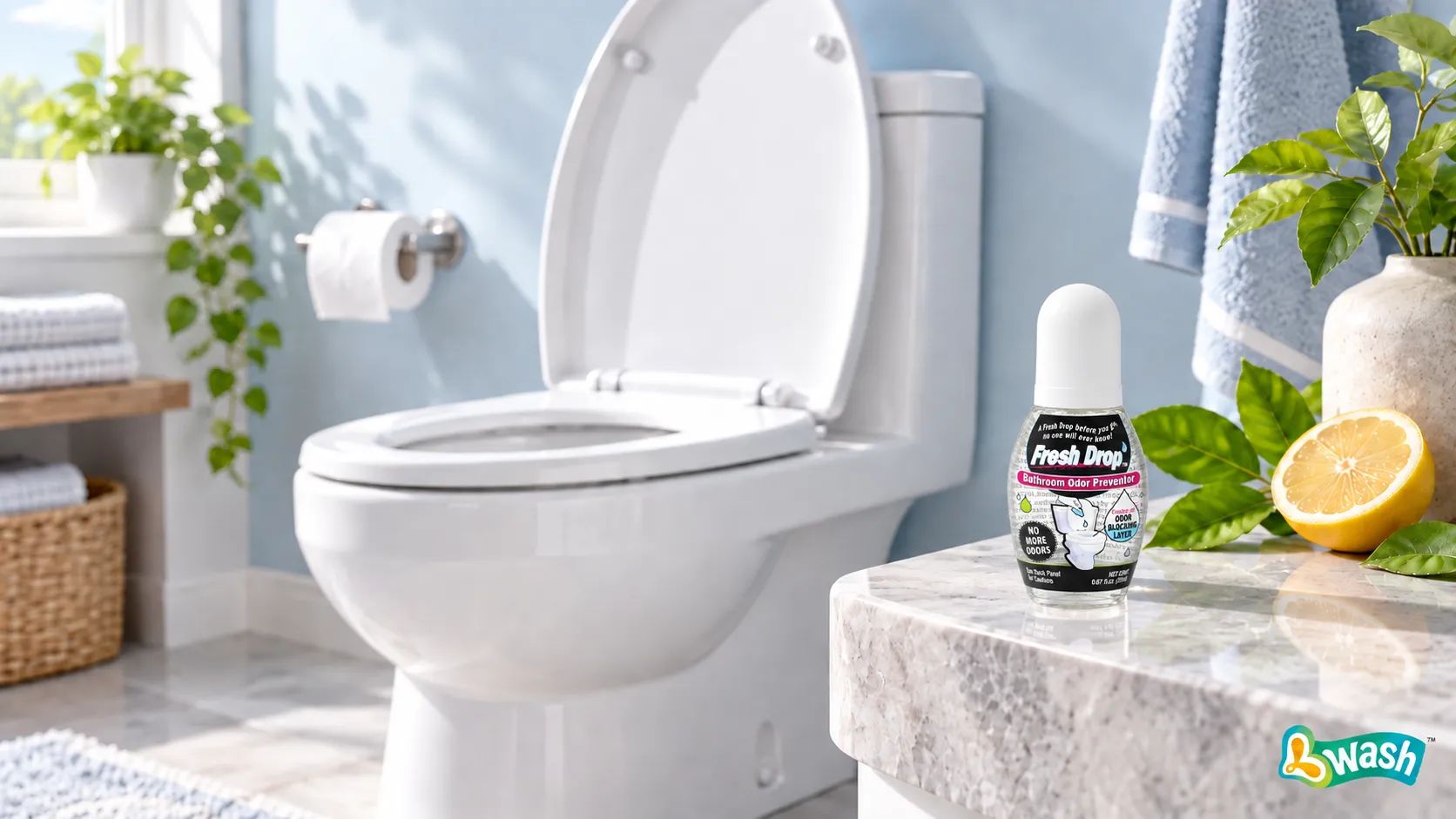
A toilet odor eliminator works best when it matches the source of the smell. A before-use drop or spray acts at the toilet-bowl water surface to help control normal bathroom odor, while a bowl cleaner is intended to remove residue. A persistent sewer or rotten-egg smell may point to a water-seal, vent, or other plumbing problem that a fragrance product cannot repair.
This guide explains the main toilet deodorizer formats, how before-you-go toilet drops work, what to try for different odor sources, and when to stop deodorizing and inspect the plumbing instead.
Reviewed: September 18, 2026.
Toilet Odor Eliminator: Quick Answer
| Odor situation | Most relevant response |
|---|---|
| Normal odor during toilet use | Apply a label-approved before-use toilet drop or spray to the bowl water before use. |
| Odor from visible bowl residue | Clean the bowl, rim, jets, seat hinges, and nearby surfaces with compatible products used exactly as labeled. |
| Lingering odor in the room after use | Ventilate the room and identify whether the source is the bowl, nearby surfaces, waste bin, drain, or plumbing. |
| Sewer or rotten-egg smell | Do not rely on fragrance alone. Check water seals, drains, vents, and plumbing with qualified help when needed. |
| RV or portable-toilet odor | Use a product specifically labeled for the relevant bowl or holding-tank system; standard toilet drops are not automatically interchangeable with tank treatments. |
In this guide
- What a toilet odor eliminator is
- How before-use products work
- Drops, sprays, cleaners, and fresheners
- How to use toilet odor drops
- Why a clean toilet may still smell
- DIY methods and mixing safety
- Private-label buyer checklist
What Is a Toilet Odor Eliminator?
Short answer: A toilet odor eliminator is a product intended to reduce, contain, neutralize, or cover an unwanted toilet-related smell. The term includes several different formats, so the product label matters more than the category name alone.
Some products are applied to the toilet-bowl water before use. Others are sprayed into the room, released continuously, used to clean the bowl, or formulated for an RV holding tank. These formats do not perform the same job, even when their packaging uses similar words such as “freshener,” “deodorizer,” or “odor eliminator.”
The word eliminator should not be read as a promise that one product can remove every possible smell. Performance depends on the finished formula, the source of the odor, the dose, the application method, and whether the user follows the label.
How Does a Before-Use Toilet Odor Eliminator Work?
Short answer: A before-use toilet odor product is applied directly to the water so the finished formula can spread across the surface before the odor is released into the room.
This is different from spraying fragrance into the air after the event. As a well-known market example, Poo~Pourri describes its before-you-go spray as creating a protective barrier on the water surface that is designed to keep bathroom odor below the surface. That is the brand’s explanation of its own product; the directions and supported claims for any other formula must be confirmed separately.
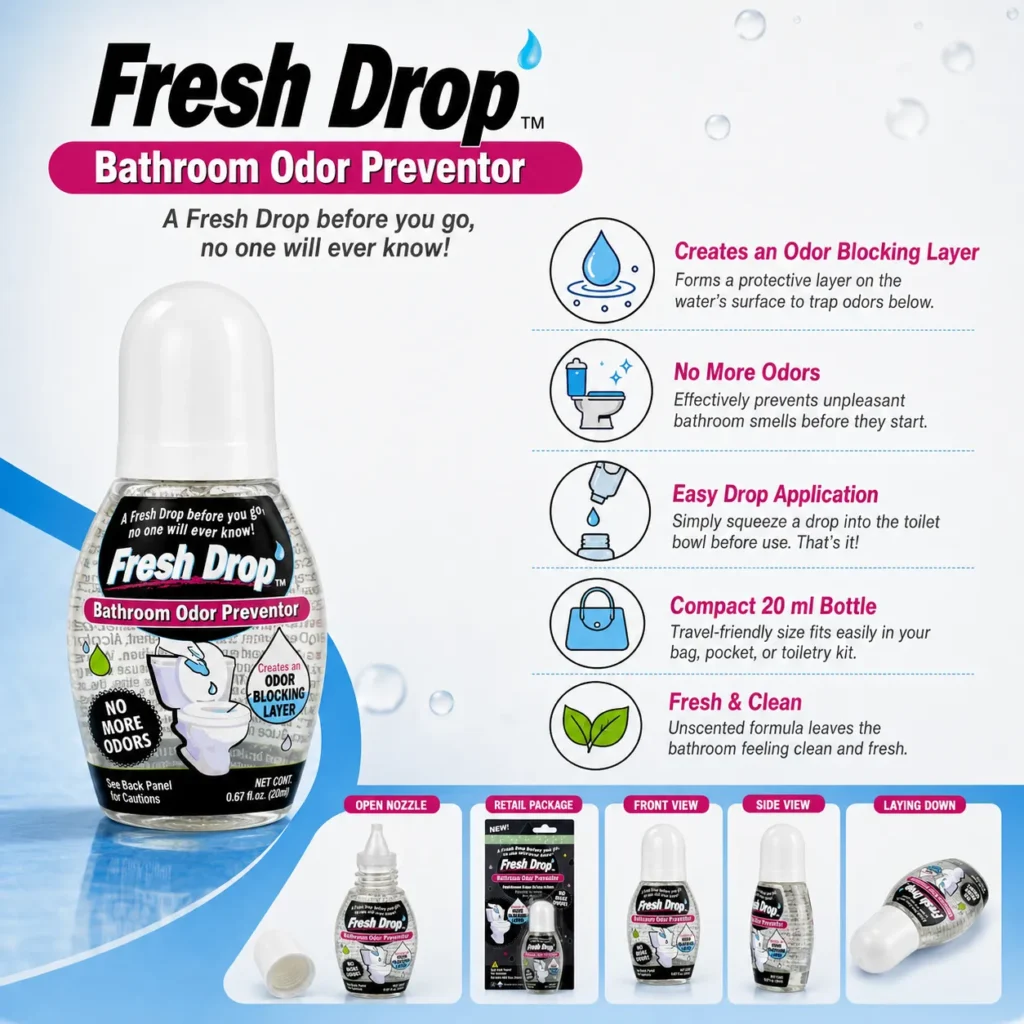
The same use concept can be delivered as a spray or as measured drops. A compact dropper format can be convenient for travel bags, guest bathrooms, office restrooms, hotel amenities, and small retail packs. The current LWASH 10 ml toilet odor drops sample is designed for before-use application and can be discussed for private-label fragrance, bottle, label, blister-card, and multilingual-packaging programs.
Toilet Drops, Sprays, Bowl Cleaners, and Air Fresheners: What Is the Difference?
Short answer: Choose the format by the odor source and the moment when the product needs to work.
| Format | Primary use | Important limitation |
|---|---|---|
| Before-use toilet drops | Measured liquid applied to the bowl water before use; compact and travel-friendly | Must be dosed and used according to the finished label; it does not clean or repair plumbing unless separately supported |
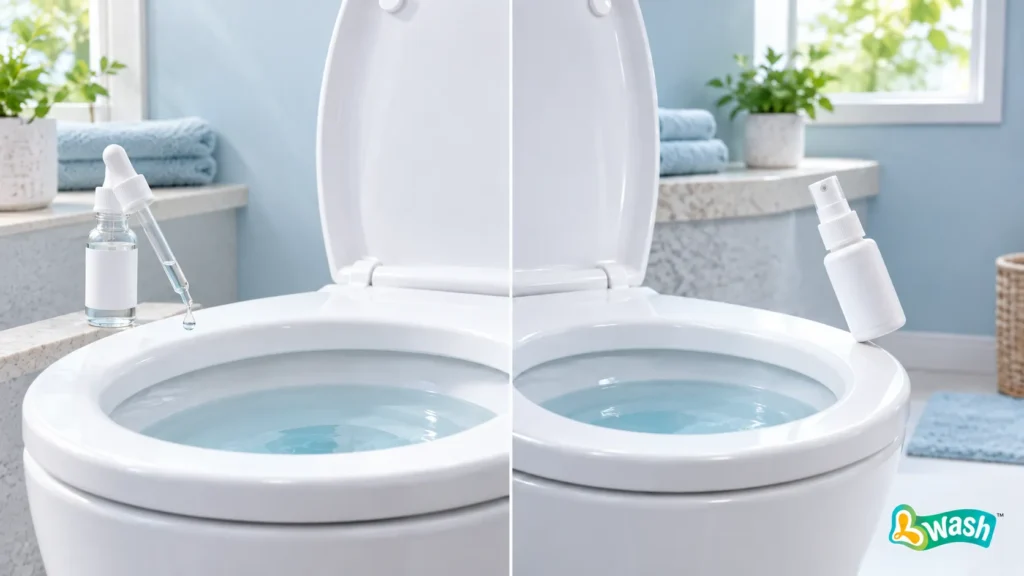
| Before-use toilet spray | Multiple sprays distribute product over the water surface before use | Spray count, bottle output, and surface coverage vary by product |
| Air freshener | Adds or releases fragrance into the room | May cover a smell without addressing its source |
| Toilet bowl cleaner | Removes label-supported soil, stains, or deposits from bowl surfaces | Not automatically a before-use odor barrier or an air freshener |
| Passive rim or cistern product | Releases ingredients during flushing or over time | Compatibility with toilet components and septic systems must be supported for the exact product |
| RV holding-tank treatment | Targets waste and odor inside a compatible portable-toilet or holding-tank system | Not interchangeable with ordinary household bowl drops unless the label specifically allows both uses |
There is no single “best toilet deodorizer” for every situation. For normal odor generated during use, a before-use bowl product is the most direct format. For residue, cleaning is the relevant task. For a sewer-like smell, the plumbing source must be investigated.
How Do You Use Toilet Odor Drops?
Short answer: Apply the label-stated amount to the toilet-bowl water before use, allow it to spread as directed, use the toilet normally, and flush.
- Read the finished label. Confirm the dose, timing, warnings, storage instructions, and permitted toilet types.
- Apply before use. Place the directed number of drops onto the water surface rather than guessing or copying another brand’s dosage.
- Allow the formula to distribute. Follow any wait time stated on the label.
- Use and flush normally. Do not add another cleaner at the same time unless both labels expressly permit it.
- Close and store the bottle. Keep it in the original or approved container and follow the label’s child-safety and storage directions.
Product-specific directions control. Drop count is not universal. Bottle size, dropper output, fragrance level, formula, target market, and supported performance claims can all change the correct instructions. Private-label artwork should use the directions approved for the final formula—not directions copied from a sample or competing product.
Why Does a Toilet Smell Even After It Has Been Cleaned?
Short answer: The odor may be coming from somewhere other than the visible bowl surface.
- Hidden residue: Check the underside of the seat, hinges, rim, exterior base, nearby floor, grout, brush holder, bin, and other splash zones.
- Infrequently used drain: A water seal can evaporate when a fixture or floor drain is not used for an extended period.
- Seal, trap, or vent problem: A damaged seal, malfunctioning trap, blocked vent, or other plumbing issue can allow odor to enter the room.
- Odor outside the toilet: A sink, shower, floor drain, waste bin, damp textile, or cleaning tool may be the actual source.
The U.S. Environmental Protection Agency explains that malfunctioning plumbing traps and vents can allow sewer gases into a building. It also notes that a dry trap can be a source and that sewer gas is more than a fragrance problem because some components can cause irritation or breathing difficulty at sufficient concentrations.
If the smell is strongly sewer-like, repeatedly returns after cleaning, or is accompanied by gurgling, leakage, a changing bowl-water level, eye or throat irritation, or breathing discomfort, ventilate the area and seek appropriate plumbing or emergency guidance. A scented drop may make the room smell different, but it cannot repair the source.
Do Baking Soda, Vinegar, Dish Soap, or Fabric Softener Eliminate Toilet Odor?
Short answer: A familiar household ingredient is not automatically the right treatment for an unknown toilet odor, and visible fizzing does not prove that an odor source has been removed.
DIY advice often ignores what was previously used in the bowl, how the ingredients interact, and whether the toilet or septic system manufacturer permits the method. Do not pour fabric softener, dish detergent, fragrance oil, or a homemade mixture into a toilet merely because it smells pleasant or creates foam.
Most importantly, never combine cleaning products unless the labels explicitly direct that combination. The U.S. Centers for Disease Control and Prevention warns never to mix household bleach—or any disinfectant—with other cleaners or disinfectants because dangerous vapors can be released. If bleach or another cleaner may already be present, do not add vinegar, ammonia, or another product.
How Do You Choose the Best Toilet Odor Eliminator?
Short answer: Start with the odor source, then check the use site, directions, evidence, warnings, fragrance, and packaging.
- Match the use moment. Decide whether you need before-use prevention, after-use room freshening, surface cleaning, continuous fragrance, or holding-tank treatment.
- Read the exact use site. A product labeled for room air is not automatically suitable for toilet water, and a household toilet product is not automatically approved for an RV tank.
- Check the supported claim. “Freshens,” “helps control odor,” “neutralizes,” “cleans,” “disinfects,” and “septic safe” are different claims and require different evidence.
- Review fragrance and ventilation. A stronger perfume is not the same as stronger odor control. Choose a fragrance level appropriate for the intended setting and follow ventilation instructions.
- Check dose and cost per use. Compare usable doses rather than bottle size alone.
- Consider portability. A secure 10 ml dropper bottle can suit travel, hospitality, sampling, and impulse-retail programs when the closure and packaging are properly validated.
What Should Private-Label Buyers Check?
Short answer: Approve the formula, claim language, directions, packaging, and target-market requirements as one complete finished product.
- Positioning: Define whether the product is a before-use toilet odor eliminator, bathroom freshener, travel accessory, hotel amenity, or another supported format.
- Formula and fragrance: Confirm fragrance direction, liquid color, ingredient disclosure, stability, and any market-specific restrictions.
- Performance: Set a label dose and verify the finished formula against the exact odor-control claims you intend to publish.
- Claims: Do not use “non-toxic,” “natural,” “eco-friendly,” “septic safe,” “disinfecting,” or universal-compatibility language without appropriate evidence and market review.
- Packaging: Validate bottle size, dropper output, closure security, leakage resistance, label adhesion, blister card, hang hole, barcode, warning panel, and shipping carton.
- Market readiness: Approve required language, net-content statement, directions, warnings, responsible-party details, and supporting documents for each destination market.
Certification language also needs discipline. The EPA Safer Choice program, for example, evaluates the complete product against ingredient, performance, packaging, pH, and other criteria before a product may carry its label. Using a particular ingredient is not the same as earning a product-level certification.
Current LWASH sample configuration
| Item | Current public product-page information |
|---|---|
| Format | 10 ml / 0.34 fl. oz. dropper bottle for before-use toilet odor control |
| Retail packaging | Blister card with hang hole; custom packaging available |
| Customization | Fragrance, liquid color, bottle, cap, label, blister-card artwork, barcode, multilingual instructions, warnings, and carton marks |
| MOQ | 5,000 bottles |
| Published lead time | 20–30 days, subject to final project confirmation |
| Target programs | Cleaning brands, importers, wholesalers, retailers, hotel suppliers, travel-size programs, and e-commerce sellers |
Buyers can review the 10 ml toilet odor drops product page, compare related formats in the toilet freshener and odor drops category, and confirm every claim and specification against the approved sample, label, and supporting documents.
Developing a private-label toilet odor eliminator? Review the LWASH toilet odor drops format, then contact LWASH with your target market, fragrance direction, bottle size, packaging style, label language, expected quantity, and claim requirements for sample and quotation discussion.
1. What is the best toilet deodorizer?
There is no single best format for every odor. A before-use drop or spray is the most direct option for normal odor released during toilet use. A bowl cleaner is more relevant when residue is the source. A persistent sewer or rotten-egg smell may require a plumbing inspection rather than a stronger fragrance.
2. How can I eliminate bad smells from a toilet bowl?
First identify the source. Clean visible residue from the bowl, rim, seat hinges, exterior base, and nearby surfaces with compatible products used as labeled. For normal use-related odor, apply a label-approved before-use drop or spray to the bowl water. If the smell is sewer-like or repeatedly returns after cleaning, check the plumbing rather than continuing to mask it.
3. Why does my toilet smell even though it is not blocked?
A blockage is only one possible cause. Odor can come from hidden residue, splash around the base or hinges, an infrequently used drain with a low water seal, a damaged seal, a vent problem, or another fixture in the room. A persistent sewer smell should be assessed as a plumbing or indoor-air issue.
4. Do toilet odor drops really work?
They can help control normal bathroom odor when the finished formula is applied to the bowl water before use and the label dose is followed. Results depend on the formula, dropper output, water-surface coverage, odor source, and directions. Toilet drops cannot repair a plumbing fault or replace bowl cleaning unless those uses are separately supported.
5. Are toilet odor drops better than toilet spray?
Neither format is universally better. Drops can offer compact packaging and measured dosing, while a pump spray can distribute several sprays across the water surface. Compare the finished formula, dose, number of uses, packaging, leakage resistance, fragrance, and supported claims rather than choosing by format alone.
6. What can I pour down a toilet to make it smell better?
Use only a product whose label permits that exact toilet application. Do not pour in fabric softener, fragrance oil, dish detergent, or a homemade mixture simply because it smells pleasant or foams. Never combine bleach or disinfectants with another cleaner; dangerous vapors can be released.
7. How do I stop a toilet from smelling like sewer gas?
Do not treat a sewer smell as an ordinary fragrance problem. Ventilate the area, check whether any nearby drain has lost its water seal, and arrange qualified plumbing help if the odor persists, is strong, or is accompanied by gurgling, leakage, changing bowl-water level, irritation, or breathing discomfort.