
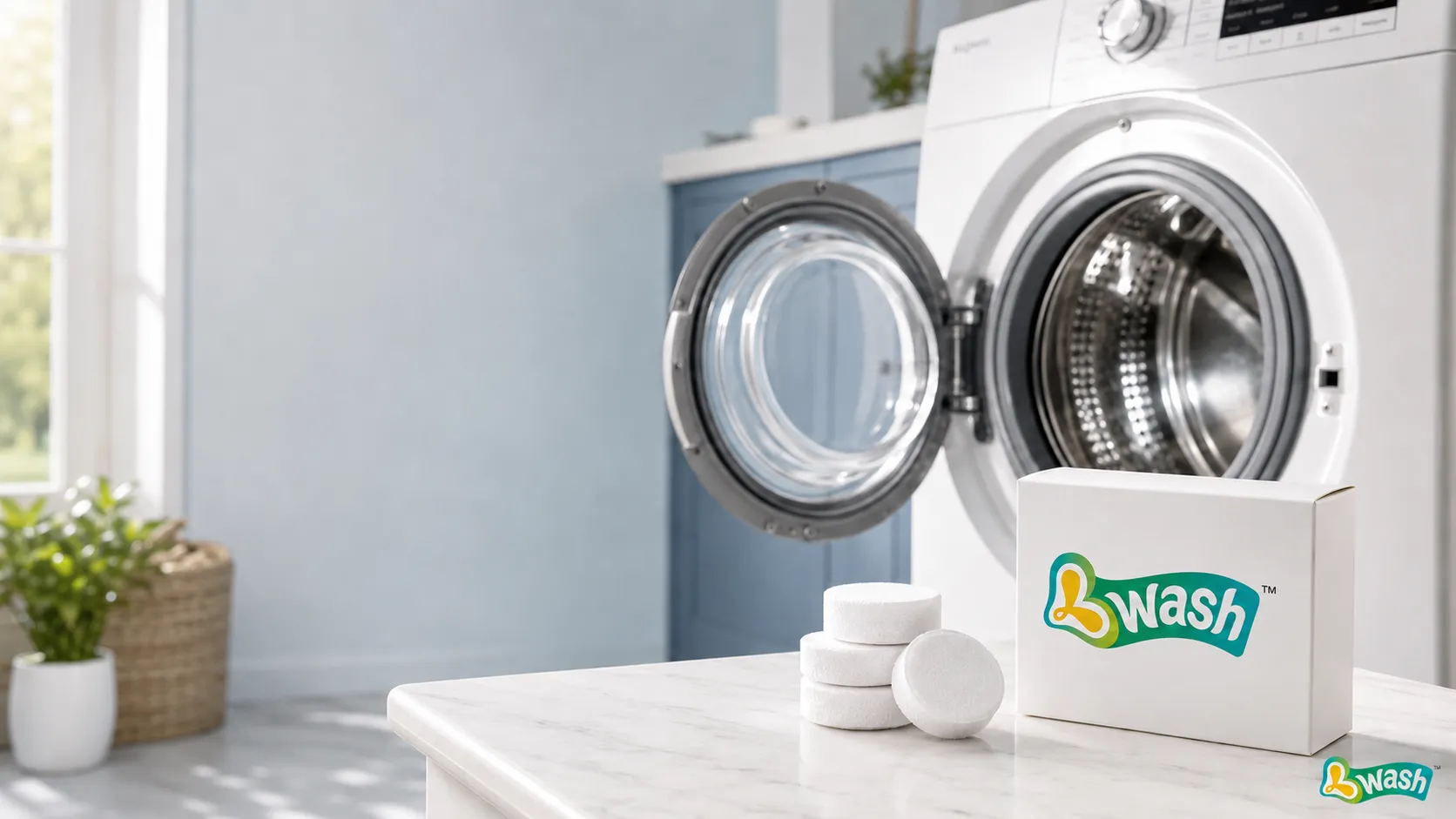
Washing machine cleaner tablets are pre-measured appliance-care products used in an empty washer to help loosen and rinse away detergent residue, dirt and odor-causing buildup from the tub or drum. They are not laundry detergent, and they do not replace cleaning the gasket, dispenser or filter by hand.
This guide answers how washing machine cleaning tablets work, where to put them, how often to use them, which mistakes to avoid and what private label buyers should confirm. For OEM projects, see LWASH washing machine cleaner tablets and the available pack, weight, fragrance and packaging options.
Quick Answers About Washing Machine Cleaner Tablets
| Question | Short answer |
|---|---|
| Do washing machine cleaner tablets work? | They can help with routine tub or drum residue and odor-causing buildup when the product label and washer manual are followed. They cannot repair a washer or replace manual cleaning. |
| Where do you put a cleaner tablet? | For the current LWASH product and many tablet cleaners, place one tablet directly in the empty tub or drum—not in the detergent dispenser. The product label controls. |
| Which cycle should you use? | Use the washer’s Clean Washer, Tub Clean or equivalent cycle if the manual allows cleaner. Otherwise, follow the cleaner label and the washer manual. |
| How many tablets should you use? | Use the labeled dose. One tablet per maintenance cycle is common, but do not assume every brand uses the same dose or double the dose for heavy buildup. |
| How often should you use them? | Monthly is a common brand and appliance-care recommendation, but washer reminders, usage, water conditions, the manual and the cleaner label should determine the schedule. |
| Can clothes stay in the washer? | No for the current LWASH product. Cleaner tablets intended for appliance maintenance are generally run in an empty washer unless the label explicitly says otherwise. |
| Can a dishwasher tablet clean a washer? | No, unless that exact product is labeled for washing machines. Dishwasher products and washer cleaners are not interchangeable. |
| Do cleaner tablets disinfect a washer? | Not automatically. Cleaning residue and controlling odor are different from making a registered disinfectant claim. |
In this guide
- What the tablets are
- How well they work
- How to use them
- Safety and compatibility
- How to choose
- Odor, black gunk and mold
- Troubleshooting
- Private label sourcing
What Are Washing Machine Cleaner Tablets?
Short answer: Washing machine cleaner tablets are solid, pre-measured cleaners made for a washer maintenance cycle, not for washing clothes.
During normal laundry cycles, detergent, fabric softener, body soil, lint and minerals can remain in damp parts of the machine. A cleaner tablet dissolves during a dedicated cycle so the wash action and rinse water can carry loosened residue away. The exact result depends on the formula, dose, cycle, water conditions and condition of the washer.
Laundry detergent cleans clothing. Washing machine cleaner cleans the appliance.
That distinction also separates a washer cleaner tablet from a laundry pod, dishwasher detergent tablet, dishwasher cleaner tablet and registered disinfectant. Similar shapes do not make these products interchangeable.
Do Washing Machine Cleaner Tablets Really Work?
Short answer: Yes, washing machine cleaner tablets can help remove routine dirt, detergent residue and odor-causing buildup when used as directed, but they cannot replace manual maintenance or appliance repair.
A tablet is most useful as preventive maintenance or for moderate interior residue. It may also loosen deposits that become visible as flakes during or after the cycle. That does not mean the tablet can dissolve hair, clear a blocked pump, repair a drain problem or reach every surface that needs wiping.
LG treats the tub, dispenser, drain filter, door gasket and water inlet filters as separate maintenance areas in its official front-load washer maintenance guide. This is a useful expectation for any brand: a tub-cleaning product is one part of washer care, not the entire job.
What do washing machine cleaner tablets help remove?
Depending on the finished formula and its supported claims, a cleaner tablet may help with detergent residue, soil film, odor-causing buildup and some mineral residue inside the tub or drum. Check the label for the exact problems the product is designed to address.
What can cleaner tablets not clean?
Cleaner tablets should not be expected to remove trapped coins, pet hair, lint clumps or debris from a filter. They also cannot fix a damaged seal, clogged hose, failing pump, drainage fault or another mechanical problem.
What Are Washing Machine Cleaner Tablets Made Of?
Short answer: Formulas vary by brand and may combine builders, oxidizing ingredients, surfactants, processing aids, fragrance or other functional ingredients; the label, ingredient disclosure and SDS for the exact product are the reliable sources.
The American Cleaning Institute explains that surfactants help remove soil while builders help cleaning ingredients work in water containing calcium and magnesium. As one brand-specific example, Church & Dwight’s OxiClean washing machine cleaner disclosure lists sodium carbonate as a builder, sodium carbonate peroxide as an oxygen bleach and a nonionic surfactant.
That example does not describe every washing machine cleaner tablet. The final LWASH formula is project-specific and must be confirmed before an ingredient list or claims are published.
How Do You Use Washing Machine Cleaner Tablets?
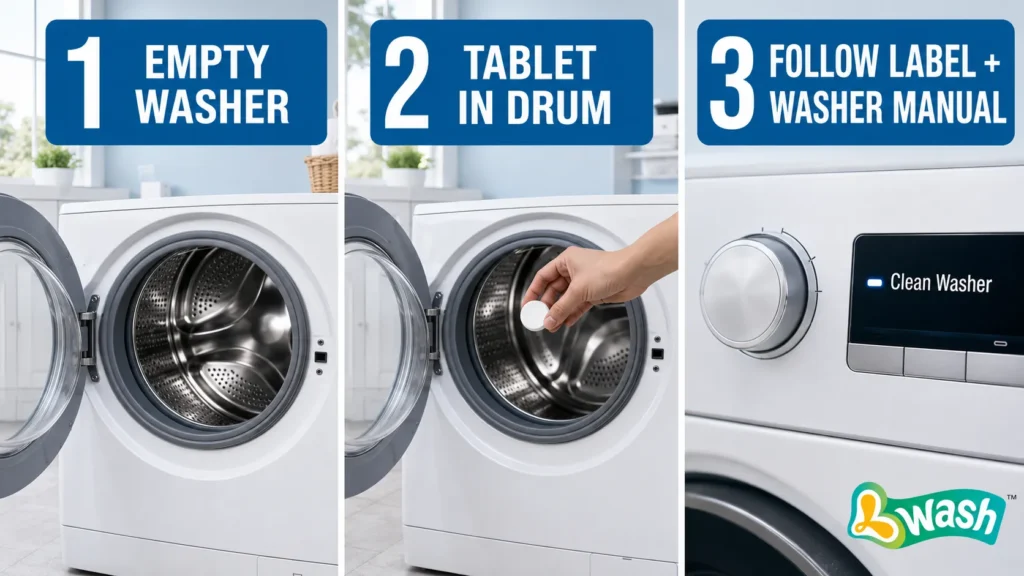
Short answer: Empty the washer, follow the tablet label and washer manual, place the labeled dose in the stated location, run the approved cleaning cycle and inspect the machine after the cycle.
- Read both sets of directions. Check the cleaner label and the manual for your exact washer model.
- Empty the washer. Remove clothing and other items.
- Add the labeled dose. For the current LWASH tablet, place one tablet directly in the tub or drum, not in the detergent dispenser.
- Select the approved cycle. Use Clean Washer, Tub Clean or an equivalent cycle when the washer manual permits cleaner; otherwise use the cycle specified on the cleaner label.
- Finish and inspect. Let the cycle complete. Remove any remaining physical debris, wipe accessible areas and run an extra rinse only when the label or manual calls for it.
Whirlpool’s washer-cleaning instructions give a brand-specific example: remove clothes, put one Affresh tablet in the washer basket and run the Clean Washer cycle. This supports the basic sequence, but another cleaner or washer may have different directions.
Where Do You Put Washing Machine Cleaner Tablets?
Short answer: Put the tablet where its label directs; for the current LWASH cleaner and many tablet products, that means directly in the empty tub or drum rather than the detergent dispenser.
Do not copy placement instructions from a powder, liquid, laundry pod or another brand. If the tablet has a wrapper, check whether the label says to remove it. Some wrappers must be removed, so never assume every film is water-soluble.
How Many Washing Machine Cleaner Tablets Should You Use?
Short answer: Use exactly the dose on the product label; one tablet per cleaning cycle is common, but the correct amount is product-specific.
More is not automatically better. Extra cleaner can create excess foam, leave residue or make rinsing harder. For a neglected washer, follow the label’s repeat-cleaning instructions rather than placing several tablets in one cycle.
Which cycle and water temperature should you use?
Use the washer’s dedicated cleaning cycle when the manual allows the product. If there is no such cycle, follow the cleaner label and model manual instead of choosing a temperature by guesswork. A dedicated cleaning cycle may control its own water level, temperature and duration.
How do you use cleaner tablets in front-load and top-load washers?
The core process is often similar: empty the washer, add the labeled dose and run the approved maintenance cycle. Front-load machines also need regular attention around the door gasket and accessible pump filter. Top-load machines may need the lid, rim, dispenser and agitator or impeller area wiped according to the manual.
How Often Should You Use Washing Machine Cleaner Tablets?
Short answer: Monthly use is common, but there is no universal schedule; follow the washer reminder, machine manual and cleaner label, and clean sooner if residue or odor appears.
Whirlpool recommends monthly cleaning in its washer-care guidance. Samsung uses a different model-specific approach: its Self Clean guidance shows reminders after about 20 washes on top-load models or 40 washes on front-load models and recommends at least monthly cleaning for low-use machines. These differences are why one brand’s interval should not be presented as a rule for every washer.
Can you use a cleaner tablet with clothes in the washer?
No for the current LWASH product. A washing machine cleaner tablet is normally used in an empty maintenance cycle. Do not add clothing, laundry detergent or fabric softener unless the cleaner label explicitly describes a combined use.
What if the washer has a Self Clean cycle?
Read the model manual before adding a tablet. Samsung, for example, says its Self Clean cycle should run with an empty washer and normally without added cleaner. Other manufacturers may allow or recommend a cleaner with their dedicated cycle.
Are Washing Machine Cleaner Tablets Safe and Compatible?
Short answer: They can be appropriate when the finished product label covers the washer type and the user follows both the cleaner directions and appliance manual; compatibility is not automatic for every tablet and every machine.
Are Washing Machine Cleaner Tablets Safe for Front-Load, Top-Load and HE Washers?
Short answer: Some products are labeled for front-load, top-load and high-efficiency washers, but users should verify the exact cleaner label and washer manual before use.
The current LWASH product line is being positioned for these common washer types, subject to final formula, sample and label confirmation. For private label projects, compatibility wording should be approved before packaging is printed rather than copied from a competitor.
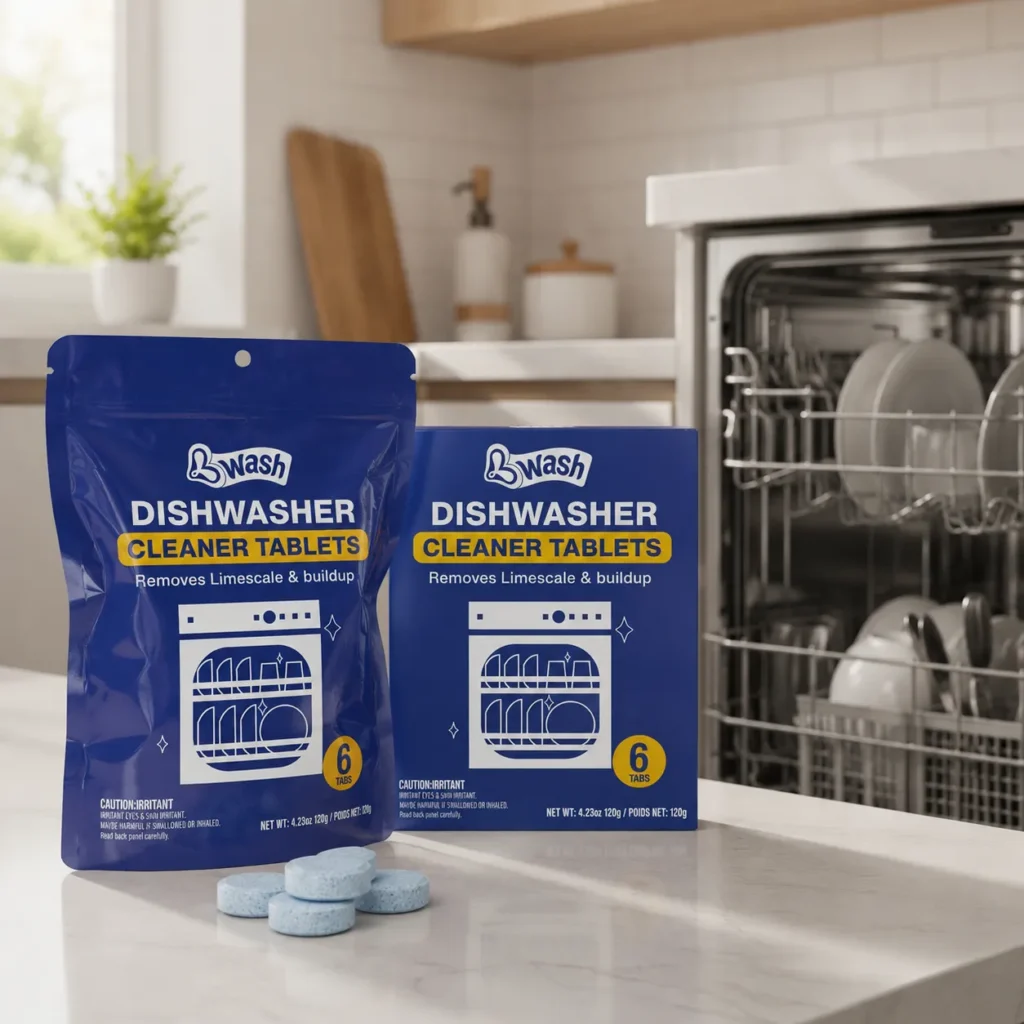
Can You Use a Dishwasher Tablet to Clean a Washing Machine?
Short answer: No—do not use a dishwasher detergent tablet or dishwasher cleaner tablet in a washing machine unless that exact product is explicitly labeled for washer use.
Dishwashers and washing machines use different cycles, water volumes, materials and soil conditions. An off-label product may foam, dissolve or rinse differently than expected. Use a purpose-made washer cleaner instead. For the reverse product distinction, see the LWASH dishwasher cleaner FAQ.
Can Washing Machine Cleaner Tablets Be Used in a Dishwasher?
Short answer: No—washing machine cleaner tablets should not be used in a dishwasher unless the exact label names dishwasher use.
A washing machine cleaner is not dishwasher detergent and is not a dishwasher cleaner. Using it in the wrong appliance is an off-label use even when both products look like white tablets.
Can you mix cleaner tablets with detergent, bleach, vinegar or other cleaners?
No. Run the cleaner alone unless the product label gives a specific exception. The CDC warns never to mix household bleach or another disinfectant with other cleaners because dangerous vapors may be released. If a washer manual recommends bleach for a separate procedure, follow that procedure without adding a cleaner tablet, vinegar, ammonia or another chemical.
Are cleaner tablets safe around children and pets?
They are concentrated cleaning products, not toys. Keep them in the original closed package, store them out of sight and reach of children and pets, and follow the exact first-aid directions on the label or SDS if exposure occurs. Do not describe a tablet as harmless or non-toxic without evidence for the finished product.
Are washing machine cleaner tablets septic-safe?
Only make that claim for a specific product whose finished formula and label support it. A septic-safe statement from one brand cannot be applied to every tablet or to an unconfirmed private label formula.
What Is the Best Washing Machine Cleaner Tablet?
Short answer: The best choice is not automatically the most heavily advertised tablet; it is the product with clear directions, suitable washer compatibility, an appropriate formula for the target problem and evidence for its claims.
Use this checklist instead of treating a generic brand ranking as a universal answer:
- the label clearly says washing machine cleaner
- front-load, top-load or HE compatibility matches the washer
- the dose, tablet placement, wrapper and cycle directions are unambiguous
- the supported use matches the problem, such as routine residue or odor-causing buildup
- ingredients, warnings and first-aid information are available
- the product avoids unsupported disinfecting, mold-killing or universal-safety claims
- pack count and cost per cleaning fit the buyer’s routine
Are tablets better than powder or liquid washer cleaner?
No format is best in every situation. Tablets offer pre-measured dosing and convenient packaging. Powders and liquids may use different ingredients, placement or dissolution methods. Compare the finished product’s instructions and performance evidence, not the format alone.
Are washing machine cleaning tablets worth it?
They can be worth it for users who want a repeatable, pre-measured maintenance routine. They are less useful when the real problem is a clogged filter, trapped item, damaged part, persistent leak or another fault that needs manual cleaning or service.
Can Cleaner Tablets Remove Odor, Black Gunk and Mold?
Short answer: A tablet may help remove residue that contributes to odor, but black gunk or visible mold can require manual cleaning, model-specific treatment and sometimes service.
How do you clean a smelly washing machine?
- Remove laundry and visible debris.
- Clean the dispenser, gasket and accessible filter according to the model manual.
- Run the approved tub-cleaning cycle with a labeled cleaner only if the manual permits it.
- Let the drum and dispenser dry after use when the manufacturer recommends leaving them open.
- If odor returns quickly, check the drain path, detergent dose and service guidance.
What is the black gunk in a washing machine?
Black or gray material may be a mixture of detergent or softener residue, soil, lint, biofilm, degraded deposits or other debris. Appearance alone cannot confirm mold. Wipe accessible material away safely and use the model manual to inspect the gasket, dispenser and filter.
Can cleaner tablets remove black mold from the rubber seal?
Do not depend on a tub-cleaning tablet to clean a rubber gasket. The gasket is a separate surface that may trap moisture, hair and residue and usually needs to be opened, inspected and wiped according to the washer manual. Persistent or extensive growth should be handled through manufacturer guidance or service.
Do washing machine cleaner tablets sanitize the machine?
Not unless the exact finished product has the required registration, test support and label directions for that claim. The U.S. EPA explains that disinfectant efficacy claims depend on reviewed data and approved label directions, including the organism and use site. Removing odor or residue is not the same as disinfecting.
Is Washing Machine Cleaner Better Than Vinegar, Bleach or Baking Soda?
Short answer: A purpose-made cleaner with clear directions is usually the simplest choice for routine washer care, while household methods should be used only when the appliance manual permits them.
Vinegar is not universally safe inside a washer. Whirlpool warns in its washing-machine vinegar guidance that repeated acid exposure may damage rubber seals and hoses. Baking soda is also not a substitute for model-specific maintenance instructions.
Bleach may be allowed for a particular manufacturer procedure, but it must never be mixed with a cleaner tablet, vinegar, ammonia or another cleaner. Follow the washer manual rather than combining DIY methods.
How Do You Deep Clean a Washing Machine?
Short answer: Deep cleaning combines a tub cycle with separate manual care for the areas the cycle may not fully clean.
| Area | What to do | Why it is separate |
|---|---|---|
| Tub or drum | Run the approved maintenance cycle with the labeled cleaner, if permitted. | The cycle circulates water through the washer interior. |
| Dispenser | Remove and rinse it as the manual directs. | Detergent and softener residue can remain in channels and inserts. |
| Door gasket | Pull back folds carefully, remove hair and lint, wipe and dry. | A tablet does not physically wipe the seal. |
| Pump or debris filter | Drain and clean it only by the model-specific procedure. | Coins, hair and lint must be removed manually. |
| Lid, door and exterior | Wipe with the manufacturer-approved method. | These surfaces are not fully washed by a tub cycle. |
Washing Machine Cleaner Tablet Troubleshooting
Why did the tablet not dissolve completely?
The cycle may have been interrupted, the product may be old or moisture-damaged, or the selected cycle may not match the label. Remove remaining tablet material as directed, check the product date and storage condition, then follow the label and washer manual. Do not add another tablet automatically.
Why are there black flakes after the cleaning cycle?
A cleaning cycle can loosen old residue, so flakes may become visible before they rinse away. Remove accessible debris and run the label-approved rinse or repeat process. If flakes continue after proper cleaning, inspect the gasket, dispenser, filter and drain system or seek service.
Why is there too much foam or residue?
Possible causes include using too much cleaner, adding detergent at the same time, using the wrong product or choosing an unsuitable cycle. Stop adding products, consult the manual and use the labeled dose on the next maintenance cycle.
Why does the washer still smell after one cycle?
The odor source may be the gasket, dispenser, filter, drain hose, standing water or a heavy accumulation that needs a label-approved repeat schedule. Persistent odor, leaking or drainage problems may require service rather than more cleaner.
What Common Washing Machine Cleaner Tablet Mistakes Should You Avoid?
- confusing washer cleaner with laundry detergent or dishwasher tablets
- leaving clothes in the washer during an empty-machine cleaning cycle
- putting a tablet in the detergent dispenser when the label says drum
- assuming every wrapper dissolves
- using several tablets because one cycle did not solve a neglected machine
- mixing the tablet with detergent, bleach, vinegar, ammonia or another cleaner
- assuming every cleaner works in every front-load, top-load or HE washer
- expecting a tablet to clean the gasket, dispenser and filter without manual work
- claiming mold killing, sanitizing or disinfection without approved evidence
- using more cleaner when the washer actually needs repair
What Should Buyers Check Before Sourcing Washing Machine Cleaner Tablets?
Short answer: Private label buyers should approve the product specification, directions, compatibility, safety documents, claims and packaging as one connected system before bulk production.
A practical sourcing checklist includes:
- target market and sales channel
- tablet count, unit weight, dimensions and appearance
- formula direction and fragrance preference
- empty-washer instruction and exact tablet placement
- dose, wrapper, cycle, water-temperature and repeat-use wording
- front-load, top-load and HE compatibility evidence
- ingredient disclosure, SDS, warnings and first-aid text
- support for residue, odor, mineral, mold, septic or other proposed claims
- retail box, blister card, barcode, label language and carton requirements
- sample testing in representative washer types before artwork approval
- MOQ, shelf life, production timing and reorder plan
Buyers building a wider appliance-care or home-care range can also use the LWASH household cleaner manufacturer guide to prepare a clearer sourcing brief.
Which LWASH sample pack options are currently shown?
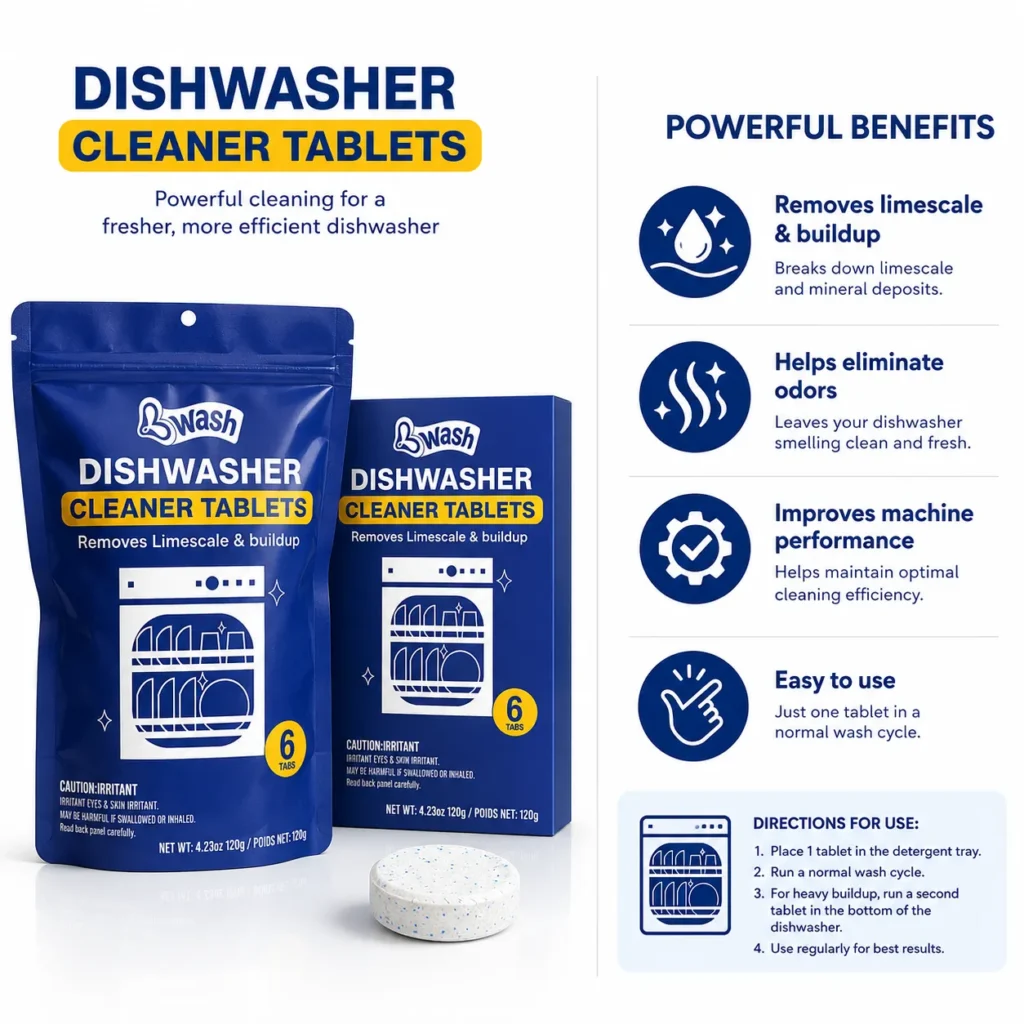
The current product page shows 6-tablet and 28-tablet retail boxes, with sample specifications including 6 × 35 g, 6 × 20 g and 28 × 12 g. These are sample configurations, not one fixed universal SKU.
| Sample configuration | What buyers still need to confirm |
|---|---|
| 6 × 35 g | Final tablet dimensions, formula, fragrance, packaging and label directions |
| 6 × 20 g | Final tablet dimensions, formula, fragrance, packaging and label directions |
| 28 × 12 g | Final tablet dimensions, formula, fragrance, packaging and label directions |
LWASH also lists custom logo, tablet count, tablet weight, fragrance, artwork, warning panel, barcode and carton support. The page currently lists a 5,000-piece MOQ, sample availability and a three-year shelf life; final commercial terms should be confirmed for the chosen formula and packaging plan.
Can Washing Machine Cleaner Tablets Be Private Label?
Short answer: Yes. Washer cleaner tablets are suitable for private label programs when the formula, tablet specification, packaging, use directions and claims are confirmed together.
LWASH supports overseas cleaning brands, importers, distributors, wholesalers, retail buyers and e-commerce sellers. Buyers can discuss 6-tablet or 28-tablet pack directions, 12 g, 20 g or 35 g sample weights, fragrance, color box or blister-card packaging, custom artwork, warning language and export carton details.
Before printing a claim such as “compatible with all washers,” “septic-safe,” “kills mold,” “disinfects” or “non-toxic,” confirm that the finished product and target-market documentation support it. To request samples or discuss a private label project, contact LWASH.
More Washing Machine Cleaner Tablet FAQs
Are washing machine cleaner tablets the same as laundry pods?
No. Laundry pods contain detergent for clothing. Washer cleaner tablets are for an empty appliance-maintenance cycle. Read the package name and intended use before putting any tablet in the washer.
Can you make washing machine cleaning tablets at home?
A DIY tablet may have uncertain dose, dissolution, storage stability and material compatibility. A labeled commercial cleaner and the washer manual provide clearer directions and safety information.
Should you leave the washer door open after cleaning?
Many manufacturers recommend allowing the interior to dry between uses, especially on front-load machines, but follow the model manual and keep an open door from becoming a child or pet safety risk.
What if the washer has no Clean Washer or Tub Clean cycle?
Follow the cleaner label and the manual for that washer model. Do not choose the hottest or longest cycle by guesswork, because water level, temperature and approved cleaner use vary by machine.
Can washing machine cleaner tablets remove limescale?
Some products are formulated to help with mineral scale, but not every washer cleaner tablet is a descaler. Look for a supported limescale or mineral-buildup claim on the exact label. A cleaner tablet also cannot change the household water hardness or replace separate care for a clogged inlet filter.
Can cleaner tablets remove pet hair or lint?
Do not rely on them for physical debris. Remove hair and lint from the gasket, tub and filter by hand according to the washer manual.
Can a cleaner tablet fix a washer that will not drain?
No. Check for a blocked filter or hose using the model instructions and arrange service when needed. A chemical cleaner is not a repair for a drainage or pump fault.
Can you wash clothes immediately after a cleaning cycle?
Follow the cleaner label. Remove any undissolved material and complete any required rinse before adding laundry.
Do the 6-pack and 28-pack use the same formula?
They can belong to the same product line, but pack count does not prove identical tablet weight, appearance or final formula. Confirm the approved SKU and sample before ordering or publishing directions.