
A dishwasher cleaner is made to clean the dishwasher itself, not to replace dishwasher detergent for washing dishes. It helps users deal with common appliance-care problems such as odor, residue, mineral buildup, grease film, and dirty interior areas that normal dishwashing may not fully address.
This FAQ answers the most common questions about dishwasher cleaner, dishwasher cleaner tablets, dishwasher cleaning tablets, vinegar, limescale, odor, placement, use frequency, and private label sourcing. For OEM and private label projects, Lwash supplies dishwasher cleaning tablets for household-cleaning brands, importers, wholesalers, retail buyers, and e-commerce sellers.
Quick Answers About Dishwasher Cleaner
| Question | Short answer |
|---|---|
| What is dishwasher cleaner? | A dishwasher cleaner is an appliance-care product used to clean the inside of a dishwasher, including areas affected by residue, odor, limescale, grease, and buildup. |
| Is dishwasher cleaner the same as dishwasher detergent? | No. Dishwasher detergent cleans dishes. Dishwasher cleaner cleans the machine interior. |
| Do dishwasher cleaner tablets work? | They can work when used as directed, especially for routine maintenance, odor support, mineral buildup, and interior residue. They do not replace filter cleaning or repair work. |
| How often should you use dishwasher cleaner? | Monthly use is a common recommendation from major appliance-care guidance, but users should follow the cleaner label and dishwasher manual. |
| Can dishwasher cleaner be used with dishes inside? | Only if the cleaner label says so. Some branded cleaners give different placement instructions for empty and loaded cycles. |
| Is vinegar the same as dishwasher cleaner? | No. Vinegar may help with some mineral residue, but it is acidic and should not be overused. A dishwasher cleaner is formulated for appliance-care use. |
What Is Dishwasher Cleaner?
Short answer: Dishwasher cleaner is a cleaning product designed for the inside of a dishwasher appliance.
People often assume that a dishwasher stays clean because it runs hot water and detergent. In real use, food particles, grease, hard-water minerals, detergent residue, and odor can still build up in the filter, spray arms, drain area, racks, seals, and tub.
GE Appliances notes that cleaning the inside of the dishwasher can help with dishwasher smells and poor cleaning performance. Its guidance also reminds users to remove debris, focus on the filter, and address mineral buildup as part of dishwasher care.
Reference: See GE Appliances: How to Clean Your Dishwasher.
What Are Dishwasher Cleaner Tablets?
Short answer: Dishwasher cleaner tablets are solid tablets used to clean the dishwasher interior during a wash cycle.
They are usually pre-measured, easy to package, and simple for customers to understand. Depending on the final formula and label, dishwasher cleaner tablets may be positioned for limescale, grease, odor, residue, and routine interior maintenance.
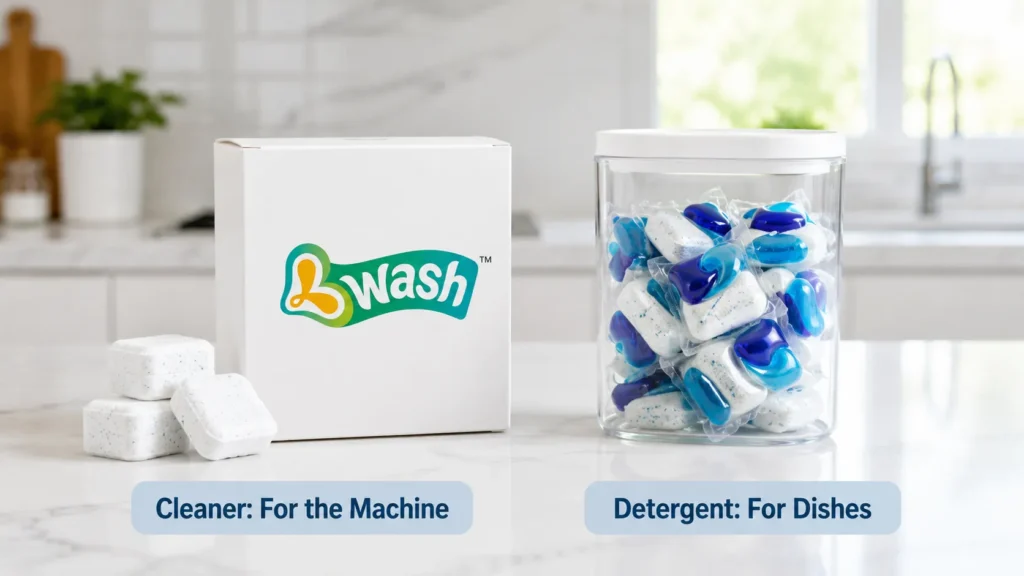
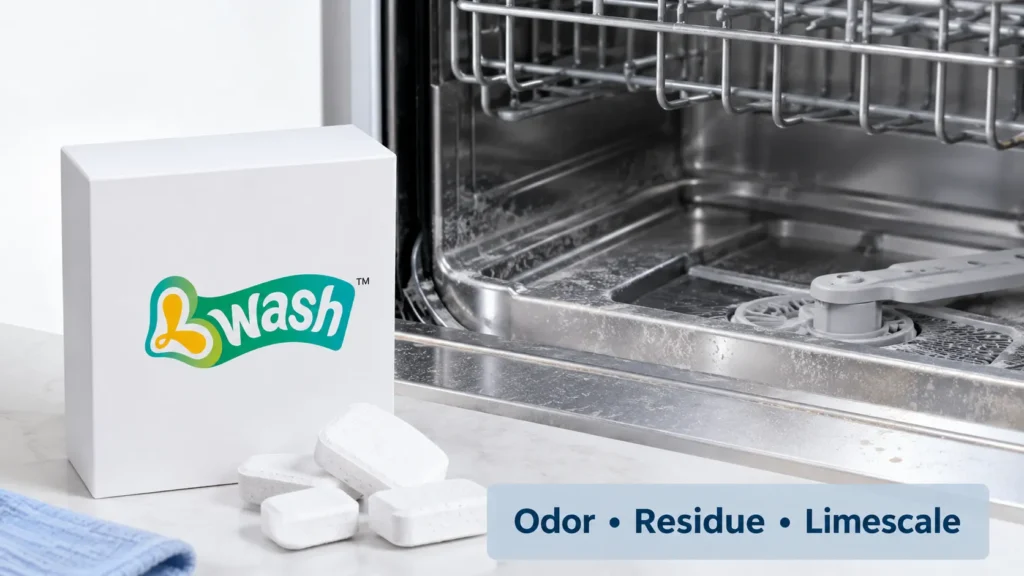
Lwash dishwasher cleaning tablets are positioned as appliance-care tablets used to clean the inside of a dishwasher. The current product sample contains 6 tablets per retail pack, 120g total net weight, with about 20g per tablet, and the package states that the tablets remove limescale and buildup when used as directed.
Are Dishwasher Cleaner Tablets the Same as Dishwasher Detergent Pods?
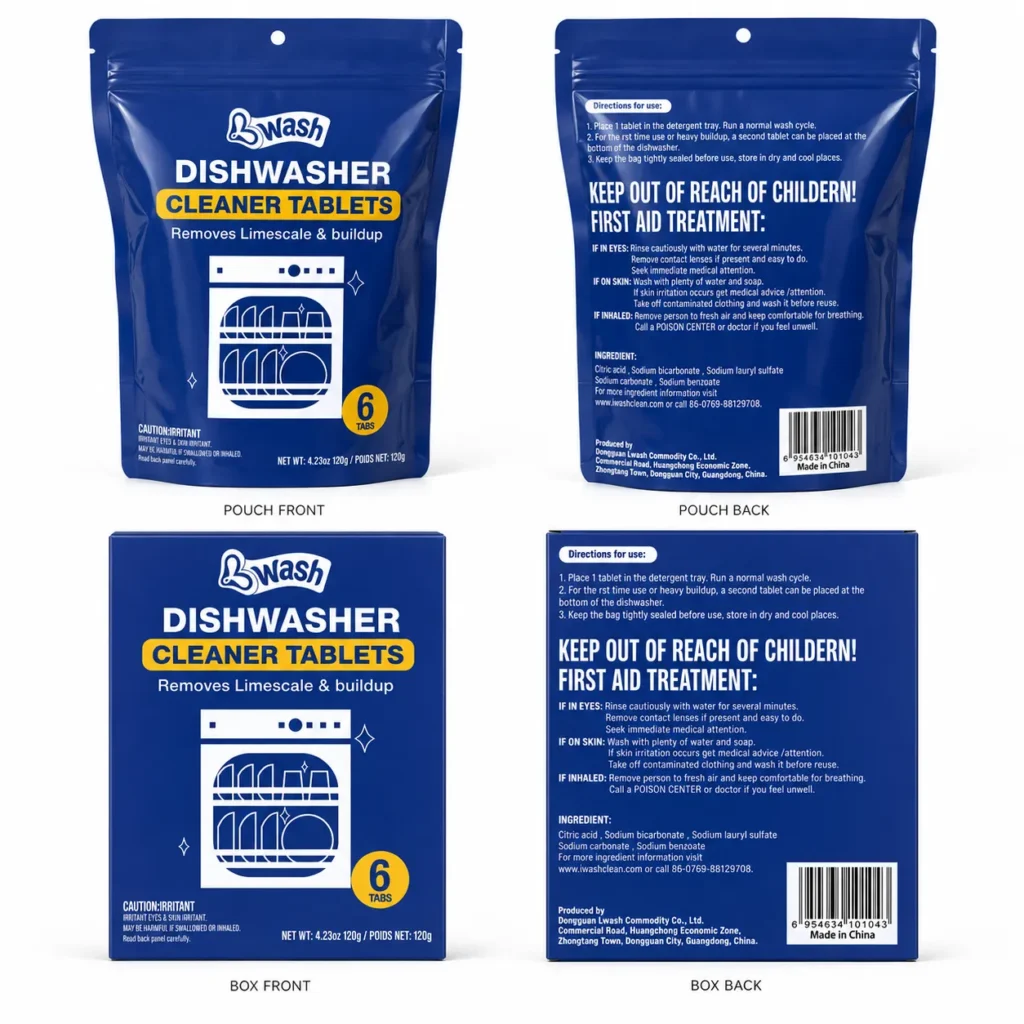
Short answer: No. Dishwasher cleaner tablets and dishwasher detergent pods are not the same product.
Dishwasher detergent pods, packs, tablets, powders, and gels are designed primarily to wash dishes. Dishwasher cleaner tablets are designed to clean the machine itself. This distinction matters because users often search for “dishwasher tablets” and may mix up dishwasher cleaner tablets with detergent tablets.
A simple rule for product pages and labels is:
Dishwasher detergent cleans dishes. Dishwasher cleaner cleans the dishwasher.
For private label buyers, this wording helps reduce customer confusion, product misuse, and negative reviews.
Do Dishwasher Cleaner Tablets Really Work?
Short answer: Dishwasher cleaner tablets can work for routine machine maintenance when they are used according to the label.
They are not magic repair tablets. They cannot fix a broken pump, blocked drain, damaged seal, or a filter that has never been cleaned. They are best understood as part of a maintenance routine: remove visible debris, clean the filter when needed, check spray-arm movement, and run the cleaner as directed.
Whirlpool’s product-help guidance says white spots or residue can build up on internal components such as spray arms and the dishwasher interior, and it recommends monthly use of a dishwasher cleaning product to help maintain the dishwasher.
Reference: See Whirlpool Product Help: Cleaning the Interior – Dishwasher.
How Do You Use Dishwasher Cleaner Tablets?
Short answer: Follow the cleaner label first, because placement can vary by product and by whether the dishwasher is empty or loaded.
For the current Lwash dishwasher cleaning tablet sample, the package directs users to place 1 tablet in the detergent tray and run a normal wash cycle. For first-time use or heavy buildup, the package suggests placing a second tablet at the bottom of the dishwasher. The final label should confirm the exact use instructions before bulk production or publication.
Whirlpool’s affresh guidance gives an example of why the label matters: when cleaning without dishes, it says to place one tablet in the detergent dispenser and not add detergent; when cleaning with dishes, it says to place one tablet in the bottom of the dishwasher and place detergent in the dispenser.
The best public-facing answer is not “always put it here.” It is: follow the label for the specific dishwasher cleaner and check the dishwasher manual when needed.
Where Do You Put a Dishwasher Cleaner Tablet?
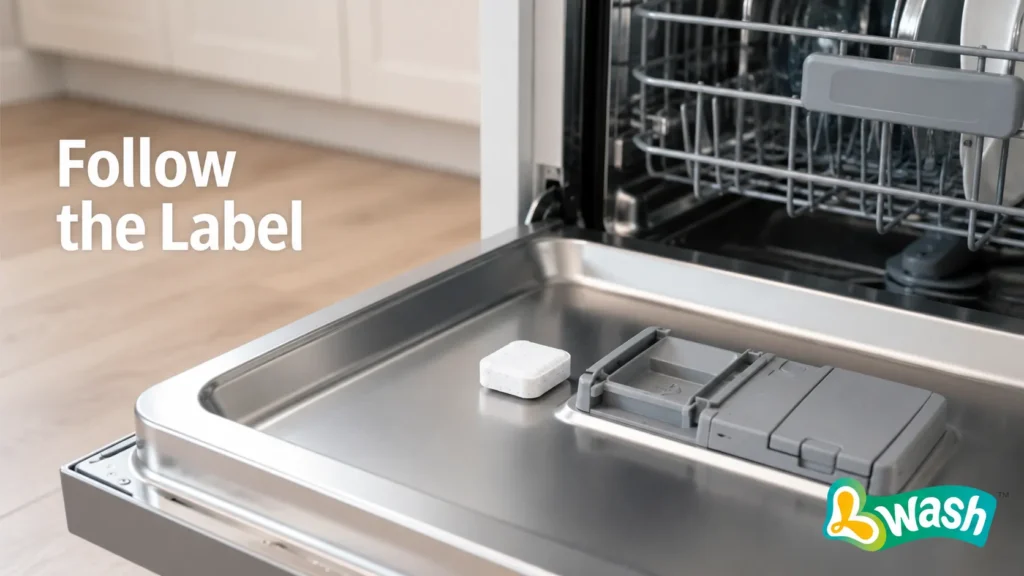
Short answer: Put the dishwasher cleaner tablet where the product label says to put it.
Common placements include the detergent dispenser, the bottom of the dishwasher, or a placement that changes depending on whether dishes are inside. This is one reason product pages should not copy placement instructions from another brand without checking the final product label.
If your product is for empty-machine cleaning, say that clearly. If it can be used with dishes, the label should explain exactly where the cleaner goes and whether regular detergent is also needed.
Can I Use Dishwasher Cleaner With Dishes Inside?
Short answer: Only use dishwasher cleaner with dishes inside if the product label clearly allows it.
Some branded dishwasher cleaners provide directions for both empty and loaded cycles. Other cleaners are intended for an empty dishwasher only. If the label does not clearly say that dishes can remain inside, the safer consumer instruction is to use the product in an empty dishwasher.
For OEM and private label buyers, this is a label decision that should be confirmed before launch. It affects claims, customer support, product photos, and the FAQ printed on the retail package.
How Often Should You Use Dishwasher Cleaner?
Short answer: Monthly use is a common recommendation, but the right frequency depends on water hardness, dishwasher use, food soil, odor, and the cleaner label.
Whirlpool recommends monthly dishwasher cleaner use to help maintain the dishwasher. GE Appliances also describes monthly use of a dishwasher cleaner dose-pack for limescale, grease, and other buildup that can cause odors.
Users in hard-water areas, busy households, commercial-style kitchens, or homes with frequent odor problems may notice buildup sooner. Light-use households may not need the same schedule. The cleaner label and dishwasher manual should always guide final use.
What Is the Best Thing to Clean a Dishwasher With?
Short answer: A good dishwasher-cleaning routine usually combines manual cleaning and a dishwasher cleaner.
For most users, the best approach is practical:
- remove visible food debris from the bottom of the dishwasher
- clean the dishwasher filter according to the appliance manual
- check that spray arms can rotate and that jets are not clogged
- run a dishwasher cleaner or descaler as directed
- avoid abrasive pads or harsh cleaners inside the dishwasher
GE recommends removing debris, focusing on the filter, and addressing mineral buildup. Bosch also emphasizes that the dishwasher filter catches food particles and should be cleaned regularly for efficient cleaning and better performance.
Reference: See Bosch: How to Clean Your Dishwasher Filter.
How Do I Deep Clean the Inside of My Dishwasher?
Short answer: Start with debris and the filter, then run a dishwasher cleaner according to the product label.
A deep-clean routine usually looks like this:
| Step | What to do | Why it matters |
|---|---|---|
| 1. Remove debris | Check the bottom of the dishwasher and wipe out visible food pieces. | Loose debris can cause odor and poor drainage. |
| 2. Clean the filter | Remove and rinse the filter according to the dishwasher manual. | A dirty filter can affect cleaning performance and smell. |
| 3. Check spray arms | Make sure spray arms rotate and jets are not clogged. | Blocked spray action reduces cleaning coverage. |
| 4. Run cleaner | Use a dishwasher cleaner tablet, liquid, or descaler as directed. | This helps address residue, grease, odor, and mineral buildup. |
| 5. Review recurring problems | If odor, water, or residue returns quickly, check loading, detergent, water temperature, and possible service issues. | Some problems are maintenance or appliance issues, not cleaner issues. |
Can Dishwasher Cleaner Help With Smell?
Short answer: Yes, dishwasher cleaner can help with odor caused by interior buildup, but odor can also come from the filter, drain area, trapped food, or machine issues.
If a dishwasher smells bad, users should first check for food scraps, standing water, a dirty filter, blocked spray arms, and buildup around seals or the drain area. A cleaner can support the routine, but it should not be the only step if the machine has visible debris or a neglected filter.
For product content, use careful wording such as “helps clean odor-causing buildup” or “supports a fresher dishwasher interior.” Avoid saying the product eliminates every odor source unless that claim is supported by testing.
Can Dishwasher Cleaner Remove Limescale?
Short answer: Some dishwasher cleaners are formulated for limescale or mineral buildup, but the label must support that claim.
Hard water can leave mineral deposits inside the dishwasher. GE Appliances notes that hard water can leave deposits inside the dishwasher and describes dishwasher cleaner products for limescale, grease, and other buildup that can cause odors.
Lwash’s current dishwasher cleaning tablet sample states that it removes limescale and buildup when used as directed. For private label projects, claims such as “limescale remover,” “descaler,” or “hard water buildup” should be confirmed against the final formula, product test, and target-market label review.
Is Dishwasher Cleaner Better Than Vinegar?
Short answer: Dishwasher cleaner is usually the clearer product choice for routine appliance-care use, while vinegar is a household method that should be used carefully.
Vinegar may help with some white residue or mineral buildup, but it is acidic. Whirlpool’s guidance says vinegar can be used as a rinse method for white residue, but also warns that using vinegar too often could damage the dishwasher.
That makes the consumer answer balanced: vinegar is a known home method, but it is not the same as a purpose-made dishwasher cleaner. If users choose vinegar, they should follow appliance guidance and avoid overuse.
Can I Put Vinegar and Baking Soda in My Dishwasher to Clean It?
Short answer: It is better to avoid mixing household cleaning methods unless the dishwasher manual or a reliable appliance guide recommends the exact method.
Vinegar and baking soda are often suggested online, but mixing methods can create inconsistent results. They may foam, neutralize each other, or fail to address filter debris and mechanical buildup. For users who want a predictable routine, a dishwasher cleaner used according to the label is easier to explain and repeat.
For product pages, do not turn the article into a DIY vinegar guide. Answer the question, explain the limitation, and bring the user back to proper dishwasher maintenance.
What Common Dishwasher Cleaning Mistakes Should Users Avoid?
Short answer: Most mistakes come from confusing cleaner with detergent, skipping the filter, using the wrong product, or ignoring the label.
Common mistakes include:
- using dishwasher detergent pods as if they were dishwasher cleaner tablets
- using hand dish soap in an automatic dishwasher
- running cleaner while dishes are inside when the label does not allow it
- putting the cleaner tablet in the wrong place
- ignoring the dishwasher filter
- blocking spray arms with poorly loaded dishes
- using vinegar too often
- using abrasive pads or strong cleaners inside the dishwasher
- expecting cleaner to fix a blocked drain or broken appliance part
Can Dishwasher Cleaner Fix Gunk at the Bottom of the Dishwasher?
Short answer: It can help with some buildup, but visible gunk should be removed manually first.
If there are food pieces, greasy residue, labels, glass, seeds, or other visible debris at the bottom of the dishwasher, users should wipe or remove them before running a cleaner. A cleaner works better when it is not expected to dissolve every physical obstruction.
If gunk returns quickly, check the filter, drain area, loading habits, water temperature, detergent use, and whether the appliance needs service.
Can Dishwasher Cleaner Remove Mold?
Short answer: Do not promise mold removal unless the product is specifically tested and labeled for that purpose.
Users may search for mold because they see black spots, odor, slime, or residue around seals and edges. A dishwasher cleaner may help clean residue and buildup, but mold claims can move into sensitive performance and safety territory.
For Lwash private label content, safer wording is “helps clean buildup and residue” or “supports regular dishwasher interior cleaning.” Avoid “kills mold,” “disinfects,” or “kills bacteria” unless the finished product has the required testing, registration, and label approval for the target market.
Can I Use Dishwasher Cleaner in a Washing Machine, Toilet, or Drain?
Short answer: No, not unless the product label specifically allows that use.
Dishwasher cleaner is designed for dishwasher appliance-care conditions. Washing machines, toilets, drains, coffee makers, garbage disposals, and bottles have different materials, water volumes, soil types, and safety requirements.
If a user wants to clean a washing machine, toilet, drain, or garbage disposal, use a product designed and labeled for that application.
What Safety Points Should Users Know?
Short answer: Users should follow the label, avoid mixing cleaners, store tablets away from children and pets, and seek help if exposure occurs.
Dishwasher cleaner tablets are concentrated cleaning products. They should be handled with dry hands when the label requires it, kept in the original package, stored away from children and pets, and used only as directed.
Poison Control is a useful safety reference for household exposure questions. It provides online help and poison-center guidance for possible poisoning situations. If someone swallows a cleaning product or has eye, skin, or breathing symptoms, users should follow the product label and contact Poison Control, a medical professional, or emergency services when needed.
Reference: See Poison Control.
What Claims Should Private Label Buyers Avoid Without Proof?
Short answer: Avoid broad safety, environmental, antibacterial, and universal compatibility claims unless the final product has evidence.
Claims that need review include:
- non-toxic
- eco-friendly
- biodegradable
- safe for all dishwashers
- safe for all septic systems
- disinfects
- kills bacteria
- antibacterial
- kills mold
- removes all limescale
- works in every dishwasher model
EPA’s Safer Choice program provides a searchable list of products that meet the Safer Choice Standard. If a buyer wants certification wording or a safer-ingredient positioning, it should be verified through the official program and the finished product should meet the relevant requirements.
Reference: See EPA: Search Products that Meet the Safer Choice Standard.
What Should Buyers Check Before Sourcing Dishwasher Cleaner Tablets?
Short answer: Buyers should confirm the formula direction, tablet size, use instructions, packaging, claim wording, and target sales channel before bulk production.
A practical sourcing checklist includes:
- tablet weight and dimensions
- single-tablet or two-tablet use instructions
- empty-cycle or loaded-cycle positioning
- detergent tray, bottom-of-machine, or other placement wording
- limescale, buildup, odor, grease, or maintenance claim support
- fragrance or fragrance-free direction
- ingredient declaration and SDS
- retail box, pouch, blister card, or custom packaging
- warning panel and first-aid wording
- barcode, carton mark, and multilingual label needs
- sample testing before final label approval
- MOQ, lead time, and shelf-life planning
Lwash supports OEM and private label dishwasher cleaning tablet projects for overseas brands, importers, distributors, wholesalers, and e-commerce sellers. Current product-page information includes custom logo support, retail box and stand-up pouch packaging, custom fragrance options, MOQ 5,000 pcs, 20-30 days production lead time, sample availability, and 3 years shelf life.
How Should a Dishwasher Cleaner Product Page Explain the Product?
Short answer: A strong product page should answer use, placement, frequency, application limits, packaging, and sourcing questions without overclaiming.
Useful sections include:
- what the product is
- what the product is not
- how to use one tablet
- where to place the tablet
- whether the dishwasher should be empty
- how often users may use it
- what buildup or odor problems it is positioned for
- what claims require final testing or certification
- available packaging and private label options
- MOQ, sample, lead time, and quote process
This FAQ structure is also useful for AI search results because each section gives a direct answer first, then explains the boundary and practical context.
Can Dishwasher Cleaner Tablets Be Private Label?
Short answer: Yes. Dishwasher cleaner tablets are suitable for private label and OEM projects when the product specification, packaging, label, and claims are clearly confirmed.
For Lwash projects, buyers can discuss dishwasher cleaner tablet pack count, tablet weight, fragrance, formula direction, packaging structure, product images, custom logo, warning panel, carton details, and final label language. The product is a natural fit for appliance-care lines, household cleaning brands, supermarket cleaning shelves, online marketplaces, and wholesale distribution.
To discuss samples, MOQ, packaging, or private label artwork, view the Lwash Dishwasher Cleaning Tablets Manufacturer page or contact Lwash.
More Dishwasher Cleaner FAQs
Do you really need dishwasher cleaner?
Many households benefit from dishwasher cleaner as part of routine maintenance, especially if the dishwasher has odor, residue, hard-water buildup, or frequent use. It should be used together with filter cleaning and proper loading habits.
What is the best cleaner to use in a dishwasher?
The best cleaner is one that is made for dishwasher appliance care, matches the user’s problem, and has clear label instructions. For limescale or hard-water buildup, look for a product that specifically supports that use.
Do you put dishwasher cleaner on the top or bottom shelf?
Follow the product label. Some cleaners go in the detergent dispenser, some go at the bottom of the machine, and some have different instructions depending on whether dishes are inside.
Can I just throw a dishwasher cleaner tablet in the bottom?
Only do that if the cleaner label says to place it at the bottom. Incorrect placement can change when the tablet dissolves and may affect the cleaning result.
How many times should you clean your dishwasher with a tablet?
One tablet per cleaning cycle is common, but some labels may allow a second tablet for first-time use or heavy buildup. Do not increase dosage unless the product label allows it.
What is the best product to clean the inside of a dishwasher?
A purpose-made dishwasher cleaner is usually the most straightforward choice. The best routine still includes removing debris and cleaning the filter, because cleaner tablets cannot replace basic maintenance.
Can dishwasher cleaner damage a dishwasher?
A dishwasher cleaner should be used only as directed. Damage risk depends on the product, dosage, placement, dishwasher material, and appliance condition. Avoid unapproved cleaners, excessive vinegar use, abrasive tools, and off-label use.
Can dishwasher cleaner tablets clean dishes?
Do not use dishwasher cleaner tablets as dishwasher detergent unless the product label clearly says they are designed to clean dishes. Dishwasher cleaner tablets are usually made for the appliance interior, not for washing dinnerware.
Can I use dishwasher detergent to clean the dishwasher?
Dishwasher detergent may wash dishes during a normal cycle, but it is not the same as a dishwasher cleaner. For appliance-care cleaning, use a dishwasher cleaner or descaler according to the label.
Can I use two dishwasher cleaner tablets at once?
Only use two tablets if the label allows it. For the current Lwash sample, the package suggests a second tablet at the bottom for first-time use or heavy buildup, but final instructions should be confirmed before publication or bulk production.