

RV toilet treatment is a broad search term. Some users mean RV black tank treatment, some mean odor control, some are comparing liquid and drop-in formats, and some are trying to understand whether household septic products or DIY methods can be used in an RV toilet system.
For questions about product use, household septic systems, DIY mixtures, and label claims, this FAQ keeps the answers cautious and points to product labels, official guidance, major RV sanitation brand references, or confirmed LWASH product information.
What is RV toilet treatment?
Short answer: RV toilet treatment is a product used for RV toilet waste holding tank care, usually the black water tank or waste holding tank.
In most search and shopping contexts, RV toilet treatment is intended to help manage odor, waste, and toilet paper inside an RV waste system. The exact function depends on the final product formula, format, dose, and approved label.
This is different from a household toilet or a household septic system. Thetford notes that RV toilets use much less flushing water than home toilets and that RV holding tanks keep concentrated waste for several days. That is why RV toilet treatment should be chosen and labeled for the RV use case, not treated as a generic household product.
Reference: Thetford’s support page explains RV plumbing and waste holding tank differences. See Thetford AQUAbio Dry support.
What does RV toilet treatment do?
Short answer: RV toilet treatment is usually designed to support odor control, waste breakdown, toilet paper breakdown, and routine holding tank care.
Different product types may use different approaches. Some treatments use enzymes, bacteria blends, deodorizing systems, fragrance, or other formula directions. Thetford describes enzyme-based RV holding tank treatments as products that use enzymes and beneficial bacteria to help break waste and toilet paper into smaller particles.
For brands and private label buyers, the important point is not to copy another brand’s claim. The final label should clearly explain what the product is designed to support and what evidence is available for the claims.
Reference: See Thetford’s enzyme RV waste tank explanation.
Is RV toilet treatment the same as RV black tank treatment?
Short answer: In many product listings, the terms overlap. However, “RV toilet treatment” is a user-friendly search phrase, while “RV black tank treatment” is more specific.
An RV toilet drains into the black water tank. So when customers search for RV toilet treatment, they are often asking about black tank treatment, black water tank deodorizer, holding tank treatment, drop-ins, or liquid treatment.
For product pages and labels, use specific wording. If the product is intended for an RV black water tank, say that. If it is also intended for grey water tanks, marine holding tanks, portable toilets, or camping toilets, confirm that wording against the final formula, test data, SDS, and target-market label requirements.
Reference: LWASH’s 50-pack product page positions the sample direction for RV black water tanks, grey water tanks, boats and portable toilets, with final claim wording to be confirmed. See LWASH RV Black Tank Treatment 50 Pack Drop-Ins.
What is RV holding tank treatment?
Short answer: RV holding tank treatment is a broader term for products used in RV waste holding tanks.
In practice, the phrase may refer to black water tank treatment, grey water odor control, marine holding tank deodorizer, portable toilet treatment, or similar sanitation products. That is why users and buyers should not rely on the phrase alone.
Before using or sourcing a product, check:
- which tank the product is designed for
- whether it is for black water, grey water, marine, portable toilet, or multiple applications
- how much water should be added
- how much product should be used
- how often it should be used
- whether the warning panel fits the intended market
Reference: Thetford separates waste treatments, maintenance products, and multiple forms such as liquids, toss-ins, and dry products. See Thetford’s holding tank treatment guidance.
What is the difference between RV black tank cleaner and RV black tank treatment?
Short answer: RV black tank treatment is usually part of routine tank use. RV black tank cleaner is usually positioned more toward cleaning tank walls, residue, sensors, or buildup.
The two phrases can overlap in search results, but they should not be written as identical products. A treatment may be used after dumping or during regular use to support odor and waste management. A cleaner may be used periodically when the tank needs a deeper cleaning process.
If a product is both a cleaner and treatment, the label should explain that clearly. Avoid vague wording such as “cleans everything” or “prevents all tank problems.”
Reference: Thetford’s Tank Blaster example is positioned as a cleaner for grey and black holding tanks, while its treatment pages describe waste and odor treatment products. See Thetford enzyme treatment guidance.
What are RV toilet treatment drop-ins?
Short answer: RV toilet treatment drop-ins are pre-measured treatment packets, pods, sachets, or toss-in formats that are added to the RV toilet or holding tank according to the product label.
Their main advantage is convenience. Users do not need to measure liquid or loose powder. For private label and retail programs, drop-ins also make pack count, unit dose, and shelf presentation easier to communicate.
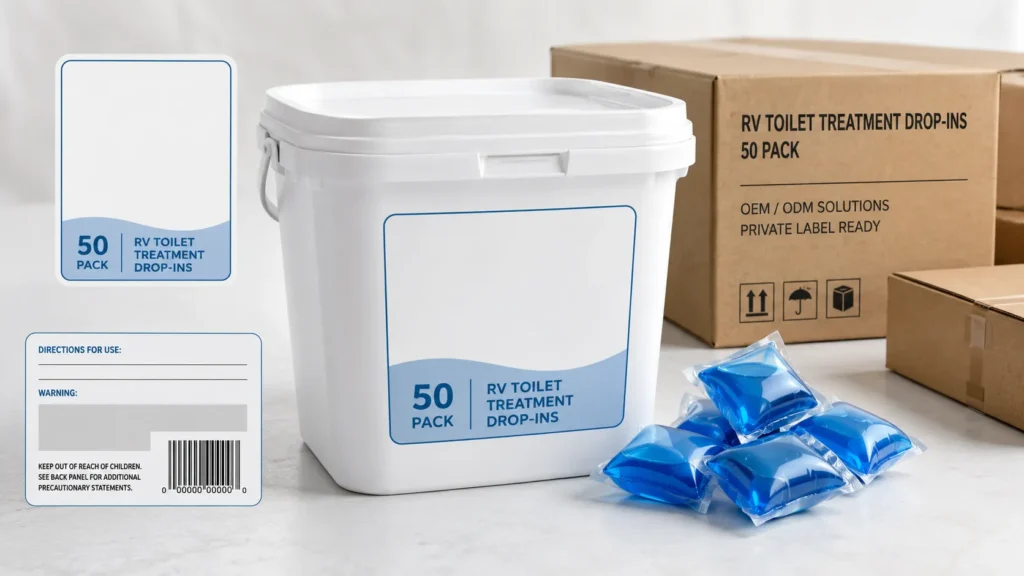
LWASH’s current 50-pack reference product is a drop-in pod / sachet direction. The sample shows 50 treatments, 30 g / 1.06 oz each pod, and 1.50 kg / 53 oz total net weight in a lidded retail tub. Final water-soluble film, pod structure, dose, tank capacity, claims, and use instructions should be confirmed before mass production.
Reference: See LWASH RV Black Tank Treatment 50 Pack Drop-Ins.
Are drop-ins better than liquid RV toilet treatment?
Short answer: Not always. Drop-ins and liquid treatments fit different users, channels, and packaging plans.
Drop-ins are convenient because the dose is pre-measured. They can work well for retail tubs, pouches, e-commerce bundles, and private label programs where pack count matters. Liquid treatments can offer flexible dosing and are familiar to many RV users, but they need bottle packaging, measuring instructions, and leak-resistant shipping.
Thetford offers treatment products in multiple forms, including liquid, toss-ins, and dry formats. This is a useful reminder that format choice is often a channel and user-preference decision, not a universal “best” answer.
Reference: See Thetford’s holding tank treatment selection page.

How do you use RV toilet treatment?
Short answer: Use RV toilet treatment according to the final product label.
A common routine is to empty and rinse the tank, add the correct amount of water if required, then add the labeled dose of treatment. However, dose, timing, water amount, and repeat use can vary by formula and tank size.
Do not use one brand’s instructions for another brand’s product. Do not mix treatment with bleach, drain opener, disinfectant, household cleaner, vinegar, baking soda, or other chemicals unless the product label and RV manufacturer clearly allow it.
Reference: Camco’s black tank maintenance guidance emphasizes flushing, water, the right treatment, and routine maintenance. See Camco’s RV black water tank maintenance guide.
When should you add RV toilet treatment?
Short answer: Many users add RV toilet treatment after dumping and rinsing the black tank, then adding the water amount required by the product label.
The exact timing depends on the product. Some treatments may be added before travel, after dumping, before storage, or before a trip. Thetford notes that enzyme treatments may need time to activate, and that tank conditions can affect performance.
For private label projects, the usage panel should state the intended timing clearly. A good label should not force the customer to guess when to add the product.
Reference: See Thetford’s enzyme treatment preparation article.
How often should you use RV toilet treatment?
Short answer: Follow the product label first. There is no single interval that fits every RV toilet treatment.
Thetford’s support pages give examples where the waste-holding tank may be emptied every 3 to 5 days depending on the additive, with hot weather or longer retention time possibly requiring additional treatment. That example is useful context, but it should not be copied as a universal rule for every product.
For LWASH private label projects, the final use frequency should be confirmed against the formula, pod weight, intended tank capacity, label language, and target market.
Reference: See Thetford Campa-Fresh Liquid support and Thetford AQUAbio Dry support.
Can you use too much RV toilet treatment?
Short answer: Do not assume that “more is better.” Follow the label dose.
Some brand-specific support pages may say that adding more than a recommended dose is possible for that brand’s product. That statement should not be transferred to another formula or private label product unless the final label and supporting documents allow it.
For B2B buyers, this is a packaging issue as much as a formula issue. If the dose is unclear, customers may overuse or misuse the product. Pre-measured drop-ins can reduce measuring confusion, but the label still needs clear tank-capacity and use instructions.
Reference: Thetford gives brand-specific dosing context on its own support pages. Treat that as Thetford product guidance, not a universal rule for all RV toilet treatments. See Thetford AQUAbio Dry support.
Why does an RV black tank smell?
Short answer: RV black tank odor can come from several causes, not only the treatment product.
Common factors include too little water, infrequent flushing, waste buildup, clogged or dirty sensors, seal problems, venting issues, high temperature, long retention time, or the wrong product for the tank. Treatment can help with odor management, but it is not a repair tool for every black tank problem.
If odor appears every time the toilet is flushed, check tank maintenance, water level, seals, venting, and whether the tank needs flushing or cleaning. If the problem continues, it may need RV service rather than a stronger chemical claim.
Reference: Camco discusses flushing, tank cleaning, treatment use, and seal checks as part of black tank maintenance. See Camco’s RV black water tank maintenance guide.
What can you put in an RV black tank to break down solids?
Short answer: Use a product that is specifically labeled for RV black tank or RV waste holding tank use.
Many RV tank treatments are positioned to support waste and toilet paper breakdown. Enzyme and bacteria treatments may support organic waste breakdown over time, depending on formula and tank conditions. However, a product should not promise instant results unless the final formula and evidence support that claim.
Avoid adding drain opener, bleach, disinfectant, strong household chemicals, or DIY mixtures to the RV black tank unless the RV manufacturer and product label clearly allow it.
Reference: Thetford explains that enzymes support the natural breakdown of waste and toilet paper in holding tanks. See Thetford AQUAbio Dry support.
Can you use septic tank treatment in an RV black tank?
Short answer: Do not assume that household septic tank treatment is suitable for an RV black tank.
An RV black tank is a portable waste holding tank that is emptied regularly. A household septic system is a fixed wastewater treatment system with a tank and drainfield. EPA guidance says septic additives are not necessary for a properly functioning household septic system and advises caution with additives, especially organic solvents or strong alkali chemicals.
For RV use, choose a product whose label specifically identifies RV black tanks, RV waste holding tanks, marine holding tanks, portable toilets, or the intended application. For household septic use, follow local septic guidance and consult a septic professional where needed.
Reference: See EPA’s septic maintenance guidance and EPA’s septic system FAQ.
Can you use Dawn, vinegar, or baking soda in an RV black tank?
Short answer: Do not use DIY mixtures as a default RV black tank treatment.
Search users often ask about dish soap, vinegar, baking soda, and homemade RV toilet treatment. These questions are common, but common does not mean verified. Household products may create foam, residue, odor changes, material compatibility concerns, or conflicts with the intended treatment formula.
The safer answer is to use products according to the RV manufacturer’s instructions and the treatment label. If a tank smells, clogs, leaks, or gives incorrect sensor readings, diagnose the tank and maintenance issue instead of adding unrelated household products.
Reference: EPA’s septic FAQ cautions against sending many household chemicals down drains in septic contexts. While an RV black tank is different from a household septic system, the same principle applies: do not improvise chemical mixtures without label and equipment support. See EPA Frequent Questions on Septic Systems.
Does RV toilet treatment freeze?
Short answer: Tank contents can freeze in cold conditions. Whether the treatment itself, the treated tank contents, or the packaging is suitable for freezing temperatures depends on the formula, storage conditions, and product label.
Thetford’s support page notes that holding tank contents can freeze and recommends RV antifreeze in both black and grey water tanks for its own product context. Do not turn that into a universal storage or performance claim for every RV treatment.
For private label buyers, cold-weather claims should be confirmed before artwork and listing copy are finalized. If there is no low-temperature stability data, do not print “works in extreme cold” or similar claims.
Reference: See Thetford AQUAbio Dry support.
Is RV black tank deodorizer the same as RV toilet treatment?
Short answer: Not always. RV black tank deodorizer focuses on odor control, while RV toilet treatment may also be positioned for waste breakdown, toilet paper breakdown, cleaning support, or routine tank care.
Some products combine deodorizing and waste treatment functions. Others focus more narrowly on odor. The label should make this clear. If the formula has only odor-control support, do not describe it as a full waste digester unless that claim is supported.
For e-commerce listings, this distinction matters because “deodorizer,” “cleaner,” “treatment,” and “waste digester” can attract different customer expectations.
Reference: LWASH’s 50-pack sample direction includes odor control support and waste/toilet paper breakdown support, with final claim wording to follow confirmed formula and label requirements. See LWASH RV Black Tank Treatment 50 Pack Drop-Ins.
What should buyers check before sourcing private label RV toilet treatment?
Short answer: Buyers should check the intended application, formula direction, product format, label wording, warning panel, dose, packaging protection, and claim support before requesting mass production.
A practical sourcing checklist includes:
- target market and language
- intended use: RV black tank, grey tank, marine holding tank, portable toilet, or other
- liquid, powder, sachet, pod, tablet, or other format
- pod weight or dose
- tank-capacity direction
- fragrance and color
- pack count
- packaging type
- warning panel and first-aid panel
- barcode and carton marks
- formula direction and SDS
- claims that need proof
- sample requirements
- MOQ, lead time, and repeat-order plan
Reference: LWASH’s 50-pack product page lists customizable items including label artwork, pod count, pod weight, fragrance, color, formula direction, warning panel, barcode, label language, carton marks, and outer carton information. See LWASH RV Black Tank Treatment 50 Pack Drop-Ins.
What packaging options are common for RV toilet treatment drop-ins?
Short answer: Common options include retail tubs, bottles, pouches, cartons, and bundle packs. The best format depends on sales channel, moisture protection, pack count, shipping, and shelf presentation.
For drop-ins and water-soluble pods, packaging needs to protect the product from moisture during storage and transport. The label also needs enough space for directions, warnings, first aid, barcode, net contents, and market-specific compliance text.
LWASH’s current 50-pack reference direction uses a lidded retail tub. Private label projects can discuss pod count, pod weight, fragrance, color, formula direction, label artwork, multilingual packaging, carton marks, and outer carton information.
Reference: See LWASH RV Black Tank Treatment 50 Pack Drop-Ins.
What claims should brands avoid on RV toilet treatment labels?
Short answer: Avoid broad or absolute claims unless the final product has evidence and the claim fits the target market.
Claims to review carefully include:
- “safe for all RV tanks”
- “safe for septic”
- “non-toxic”
- “biodegradable”
- “instant waste breakdown”
- “prevents all clogs”
- “eliminates all odors”
- “works in extreme climates”
- “keeps sensors clean”
Some of these may be valid for a specific brand or formula, but they should not be copied from competitors or sample packaging. Claims need to match the confirmed formula, SDS, ingredient declaration, testing, and label review.
Reference: EPA does not recommend household septic additives as necessary for properly functioning septic systems, and Thetford/Camco product claims are brand-specific. Use external claims as reference context, not as copy to transfer.
What information should buyers provide before requesting a sample?
Short answer: Buyers should provide enough information for the supplier to match the product format, label, and packaging to the target market.
Useful information includes:
- target country or region
- intended application
- preferred format
- target pod weight or dose
- target tank capacity statement
- fragrance and color preference
- desired pack count
- packaging style
- label language
- warning or first-aid requirements
- sample quantity
- expected order quantity
- any claim wording the buyer wants to evaluate
- reference product photos or packaging examples
For LWASH projects, buyers can start by sending the target market, expected pack size, pod weight, formula direction, fragrance request, label language, warning requirements, order quantity, and packaging design request.
Reference: See the project start information on LWASH RV Black Tank Treatment 50 Pack Drop-Ins.
Conclusion
For brands, distributors, and e-commerce sellers, the most important sourcing checks are product application, formula direction, format, dose, packaging protection, warning language, claim support, and repeat-order stability.
To discuss 50-pack RV toilet treatment drop-ins, 30 g pod directions, private label tub packaging, fragrance, color, label artwork, warning panels, barcode, and carton information, view the LWASH RV Black Tank Treatment 50 Pack Drop-Ins page or contact LWASH